Self-Portrait Dollhouse
Without a permanent home or children to pass things on to, my art is my legacy. My close-knit family saved precious items for me to keep, and in this self-portrait I place them within the timeline of my life. The dollhouse acts as a sort of stage set to play out my memories and to understand how these experiences shaped me.
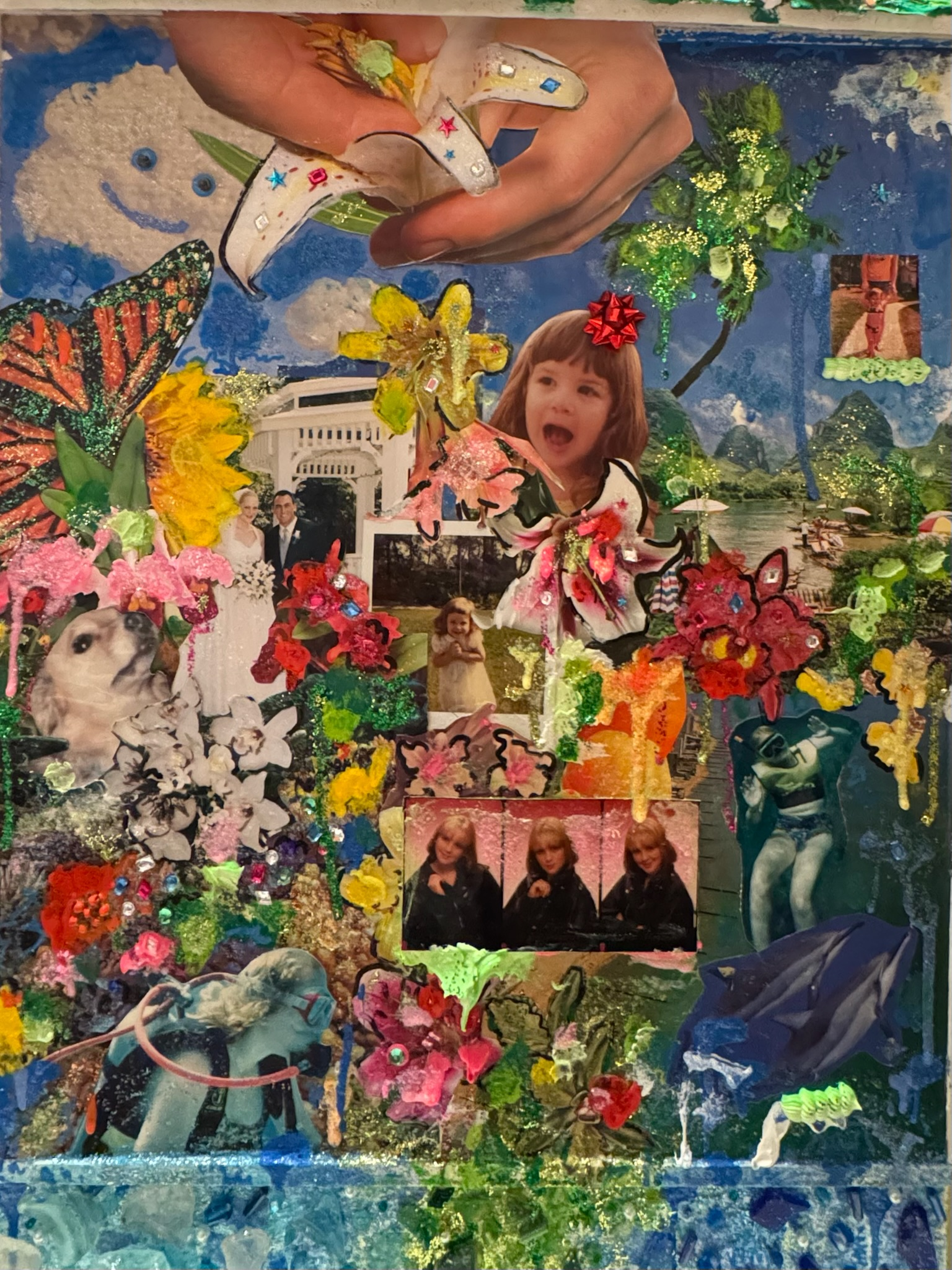
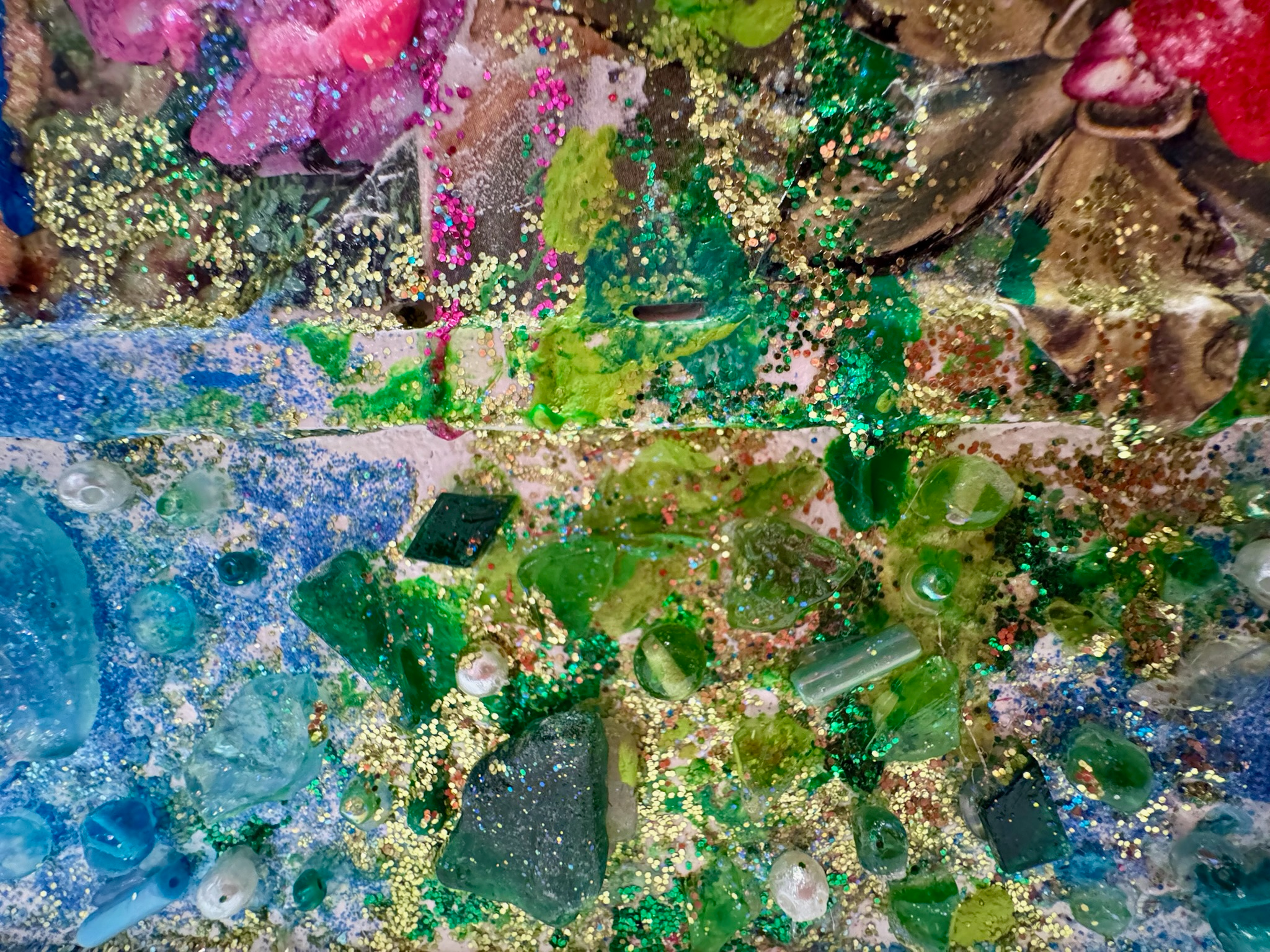
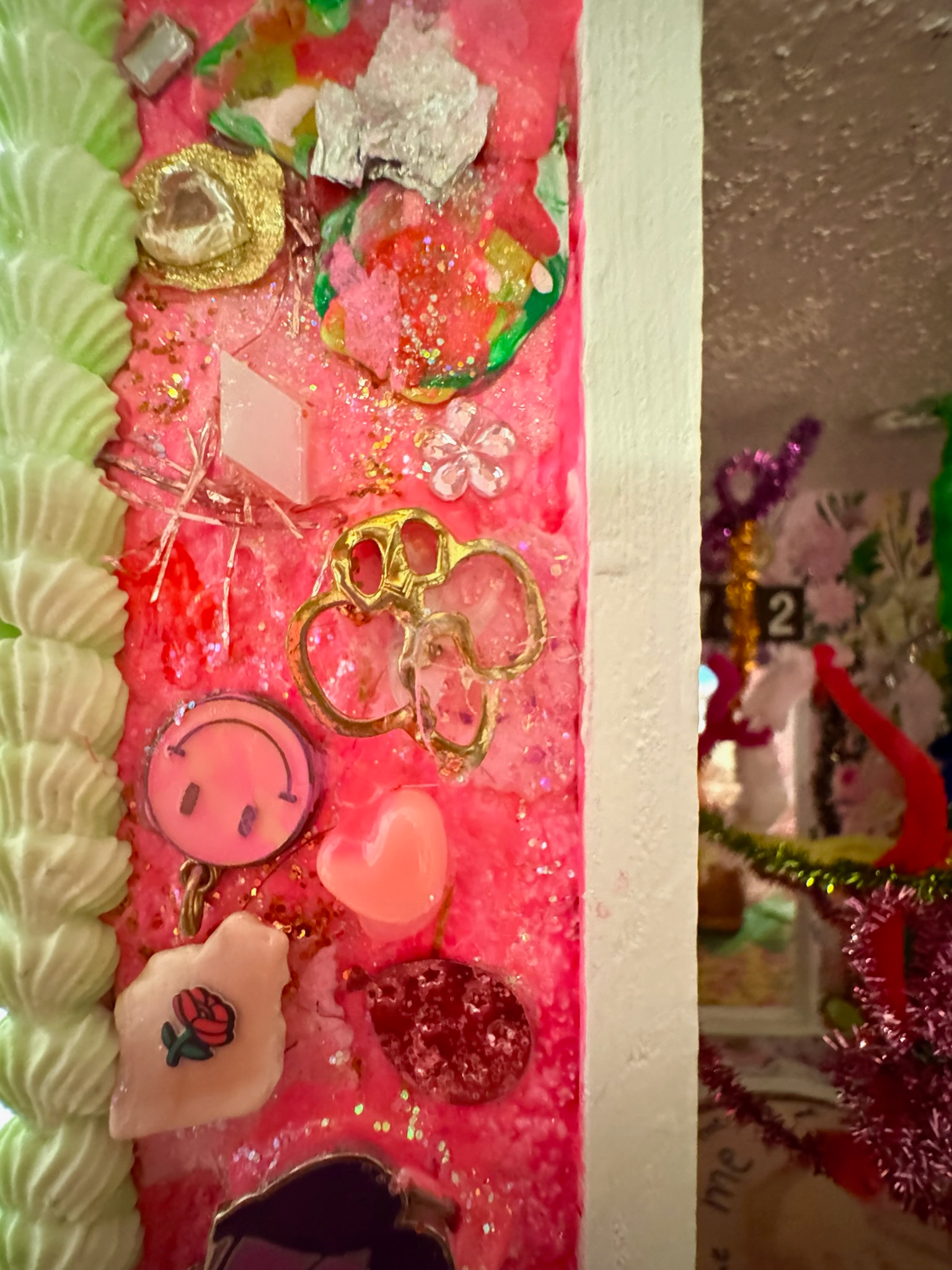
The exterior of the house isn't uniform. One wall is a massive photo collage of me: as a smiling child, Glamour Shots from the mall, getting married, and swimming (my happy place). Filling in the rest of the space are photos of my childhood dog, sky, flowers, tropical scenes, and travel spots, with layers of paint, nail polish, glitter, and frosting on top. The piped frosting conjures homemade cakes made by my mom and grandma. I don't really bake, but I discovered that lightweight spackle — a substance I'm more familiar with than buttercream — works to delicious effect when put through a piping bag. Finally, found sea glass sits at the bottom, grounding the collage.
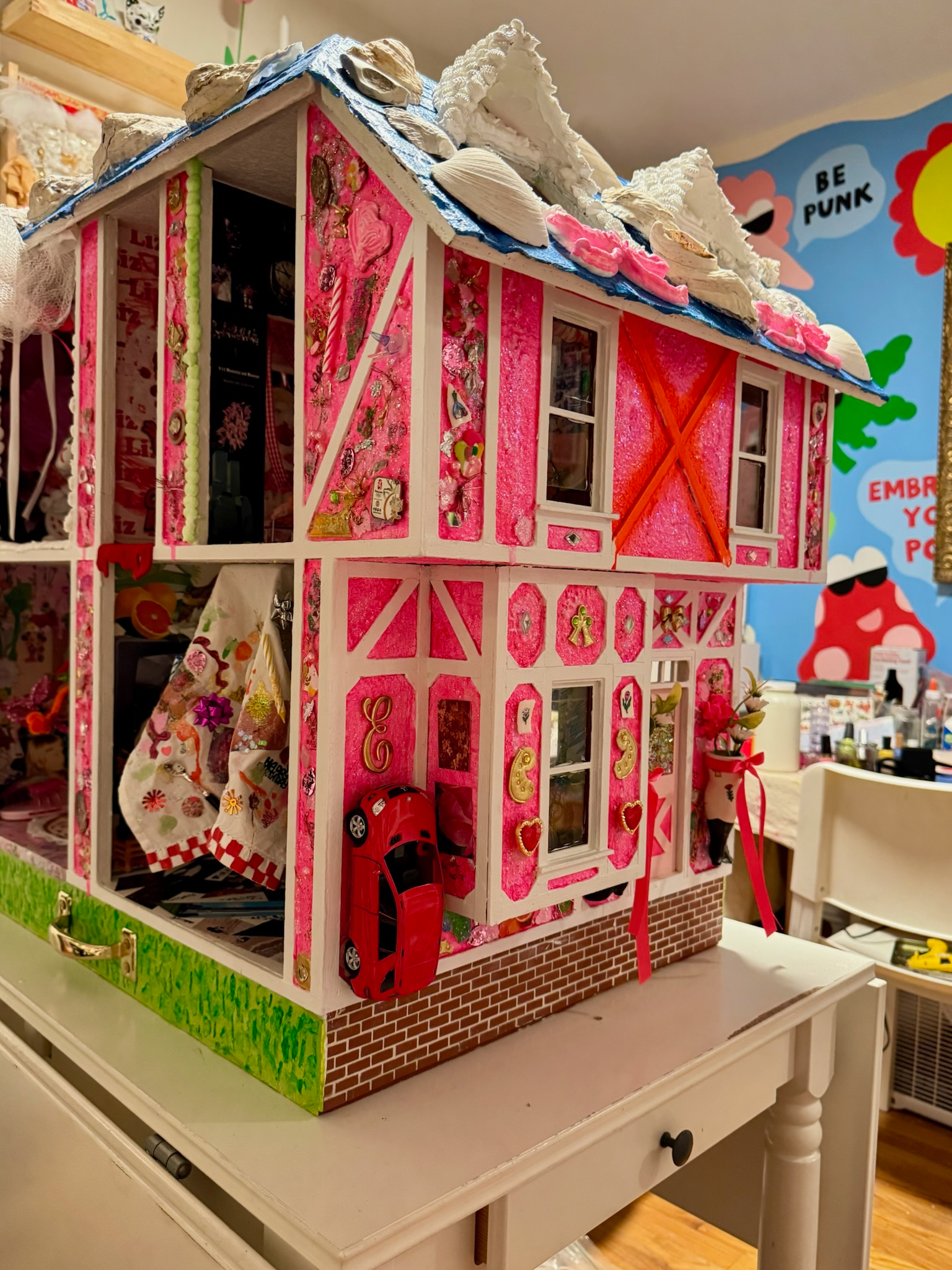
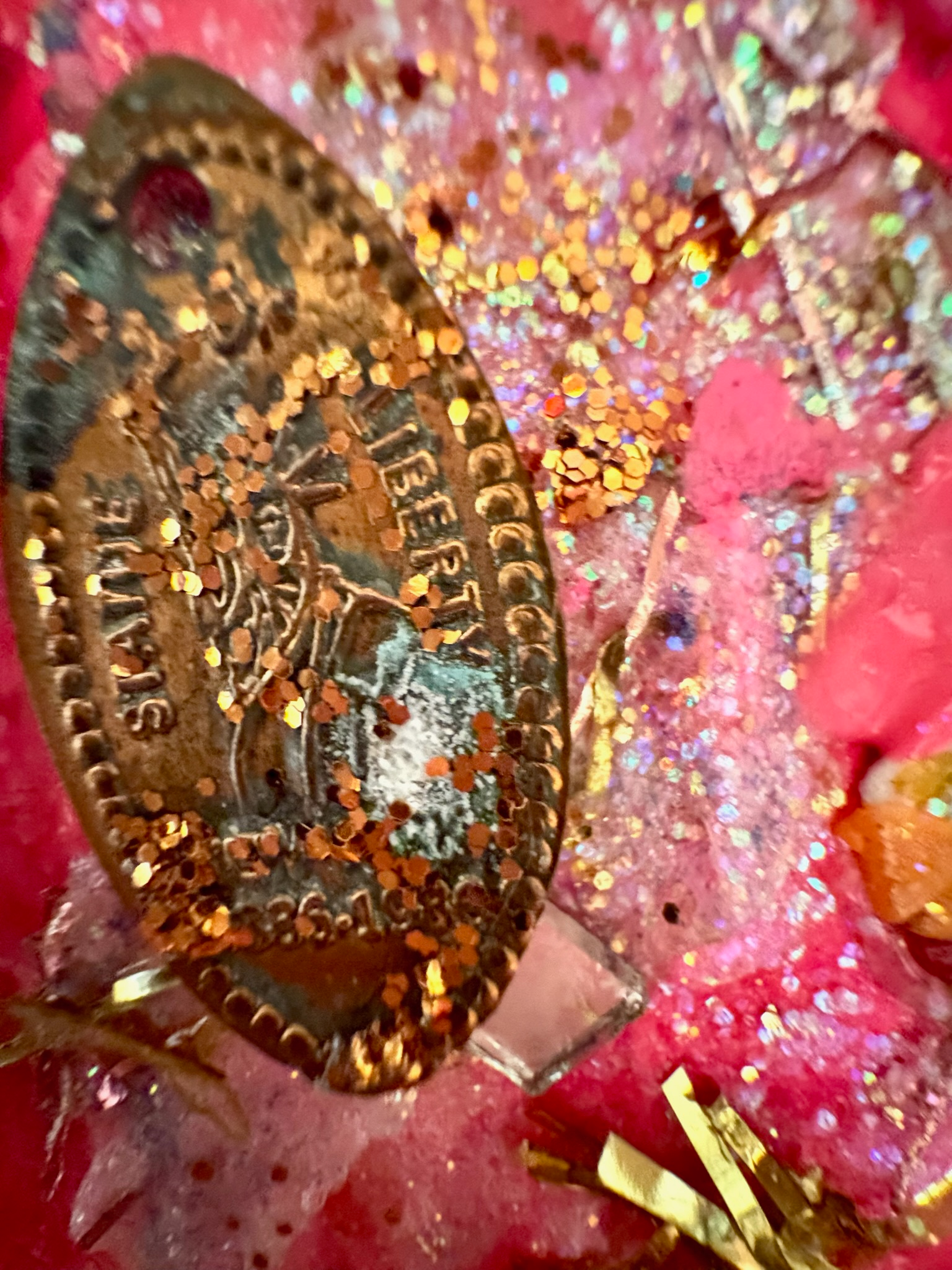
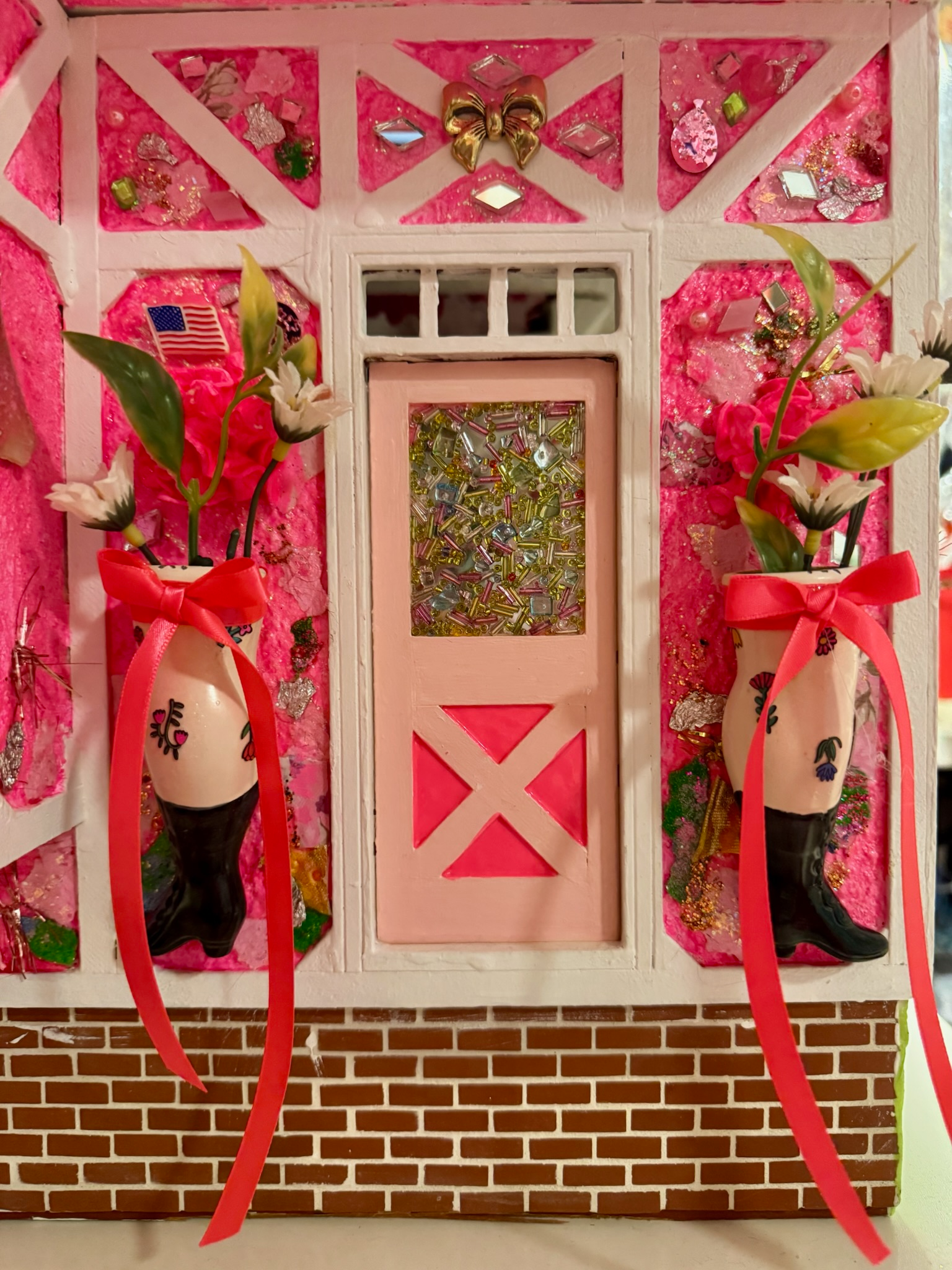
Turn the corner, though, and the dollhouse shifts into something more symbolic. The hot pink walls reflect a Barbie playhouse more than anywhere I've actually lived. On the front of the house, the ceramic legs flanking the door were made by my great-grandmother Rose in her home kiln. A doll which was never made, they now function as planters guarding the dollhouse door. The floral stickers on the legs represent my own tattoos, which themselves connect to a family legacy of flowers. The outside walls are covered with pink paint, glitter, and mementos of pins, shells, squished penny souvenirs, trinkets, and toys.
Childfree-by-choice, living in New York City, my desires and opportunities are very different from those of my ancestors. All of us are immigrants to the United States: one side from Scotland and Wales, the other from Italy and Slovakia. In 1920, at age 18, my great-grandmother Mary came through Ellis Island from what is now Slovakia. My kin spread through Pennsylvania and West Virginia. Some of us splintered off into Central Florida, where I was born between the beach and Disney World. It was my great-great-grandmother Bertha who initiated us into the Church of Christ, the Evangelical church I was raised in. Family members have moved, some have passed, but so many of my memories are set in the Florida sun that I wanted to picture us all there, together again.
Family Room
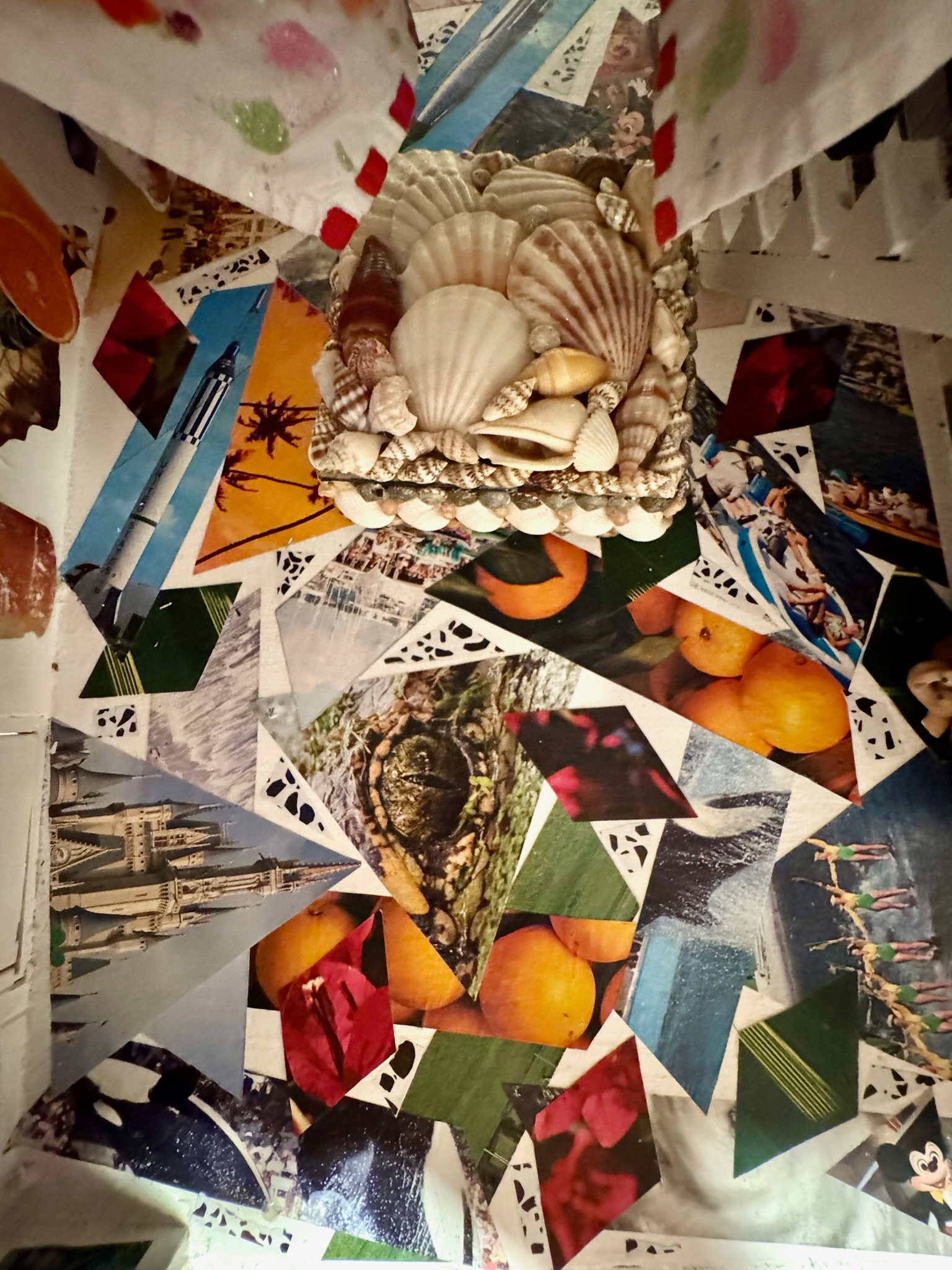
Inside on the first floor, the family room unfolds. This collective space represents events blurred together and collapsed in time. I grew up next door to my great-grandparents and a block away from my grandparents. Family photos and Florida nature prints paper the family room walls in layers, like they’ve been worn over time. My great-grandparents grew fruit and vegetable plants as well as prize-winning flowers like roses and orchids. Orange groves were a great source of pride for Floridians when I was growing up and they also cultivated a few trees in their backyard. The collaged images on the floor evoke fragmented memories of Florida life — Disney, citrus, sea animals, alligators, boats, ocean, beach.
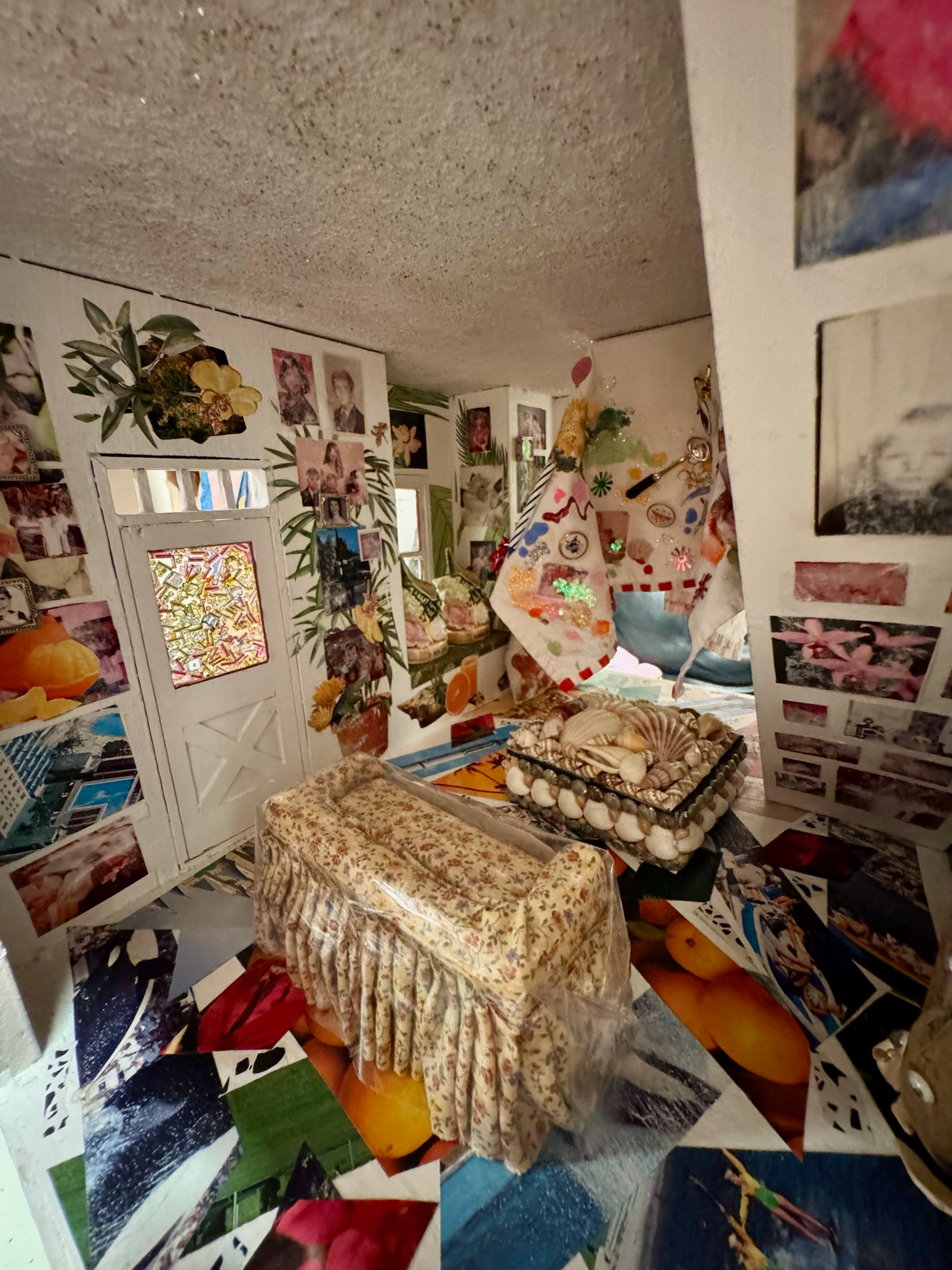
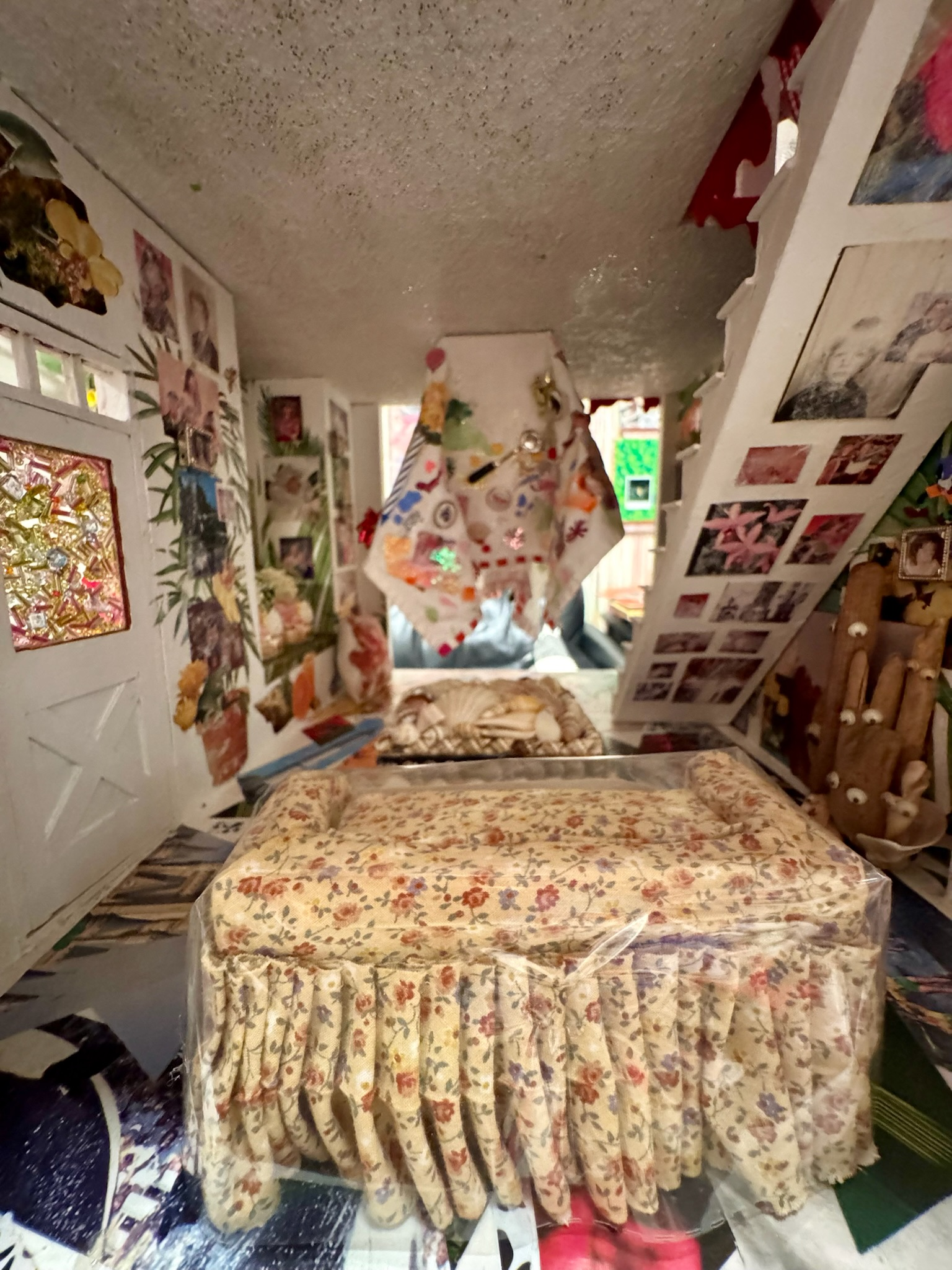
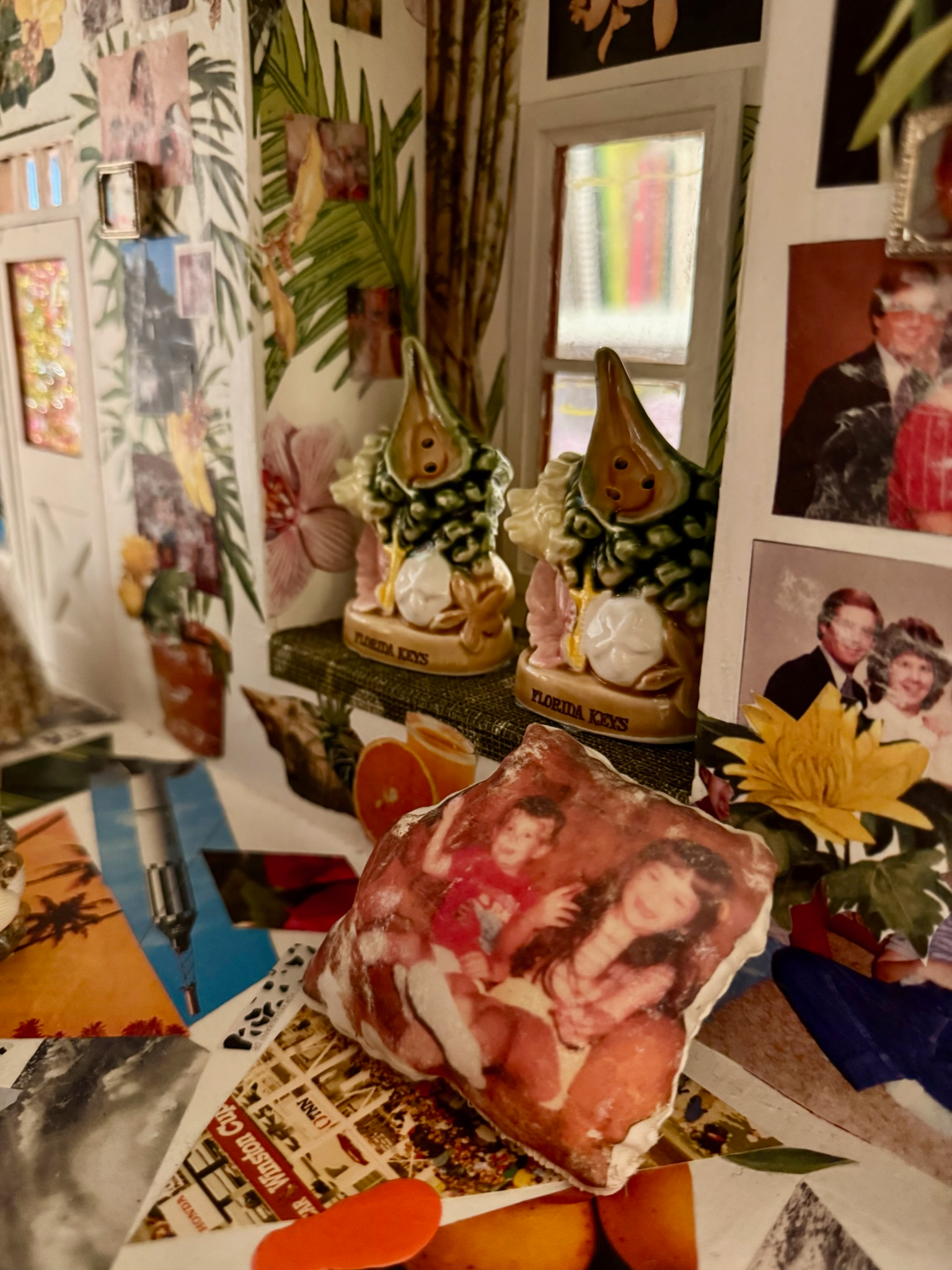
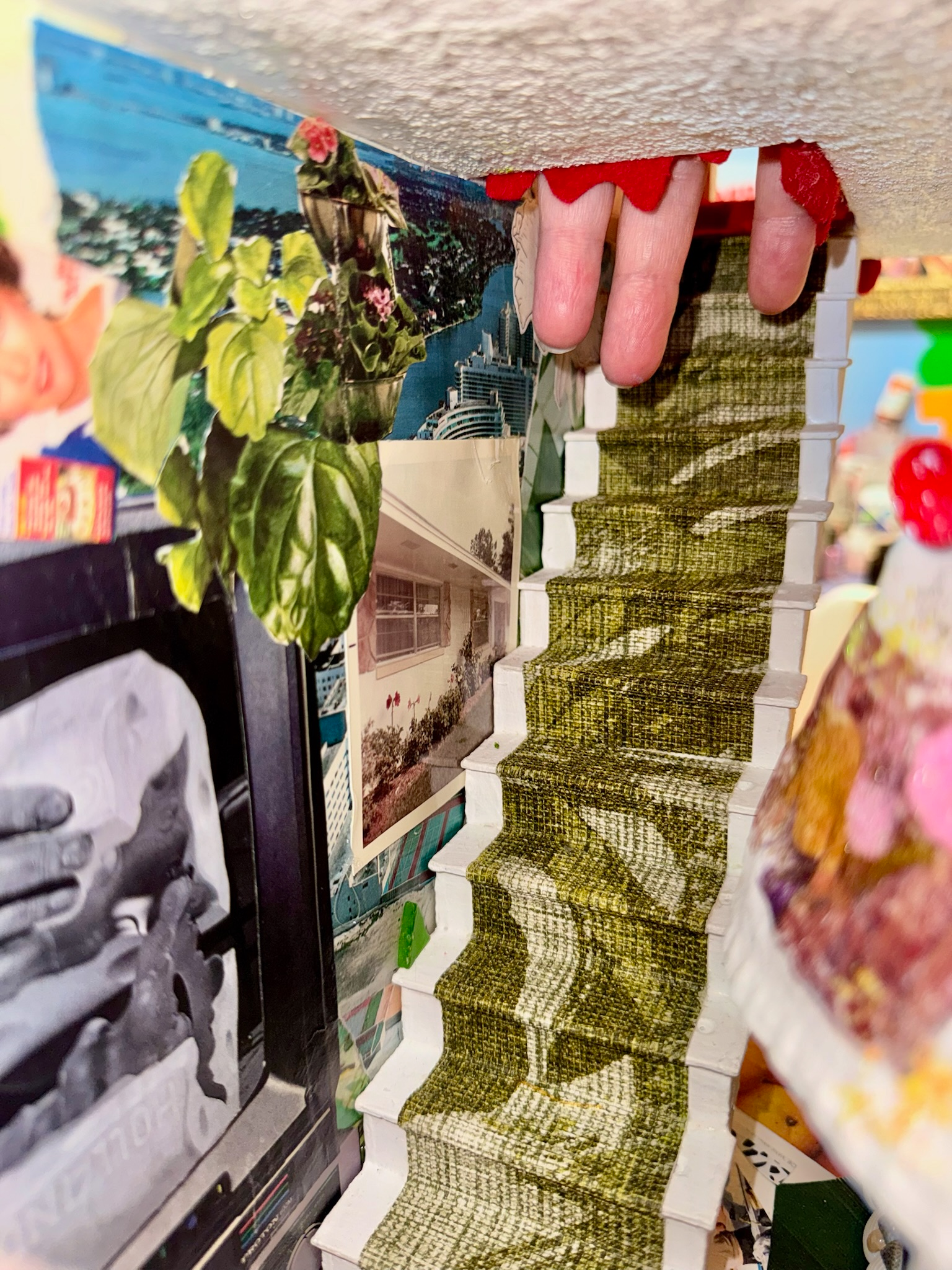
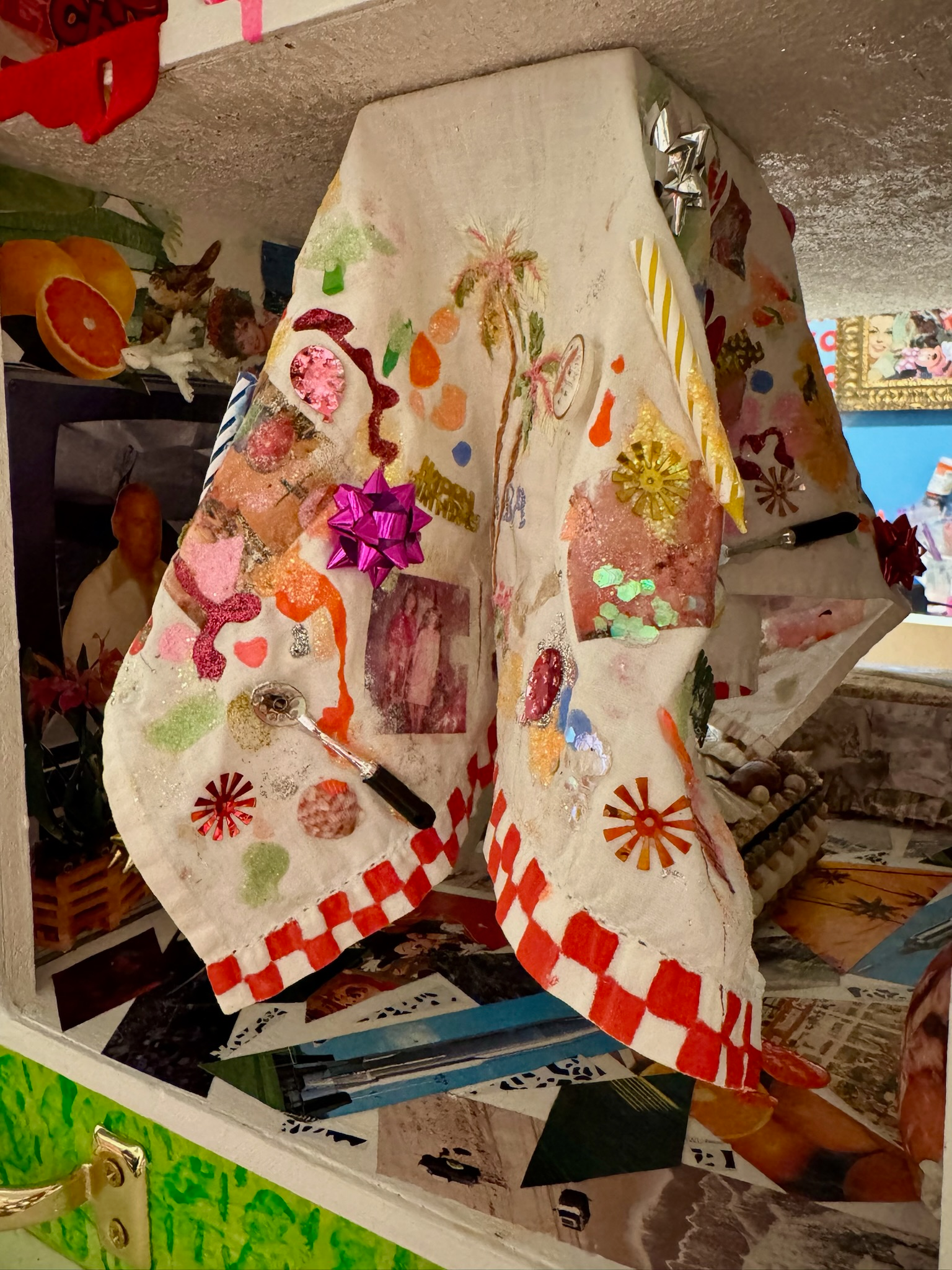
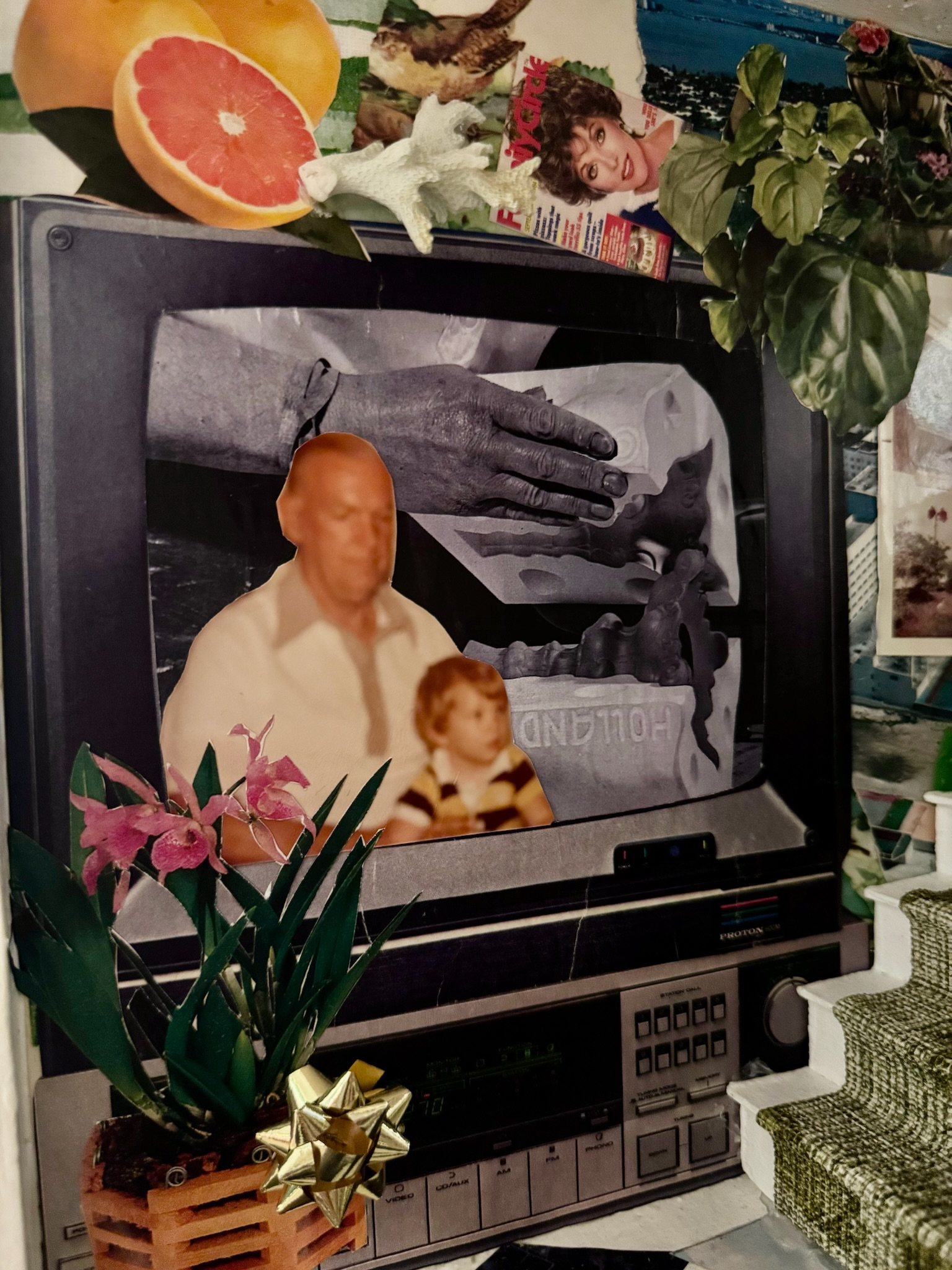
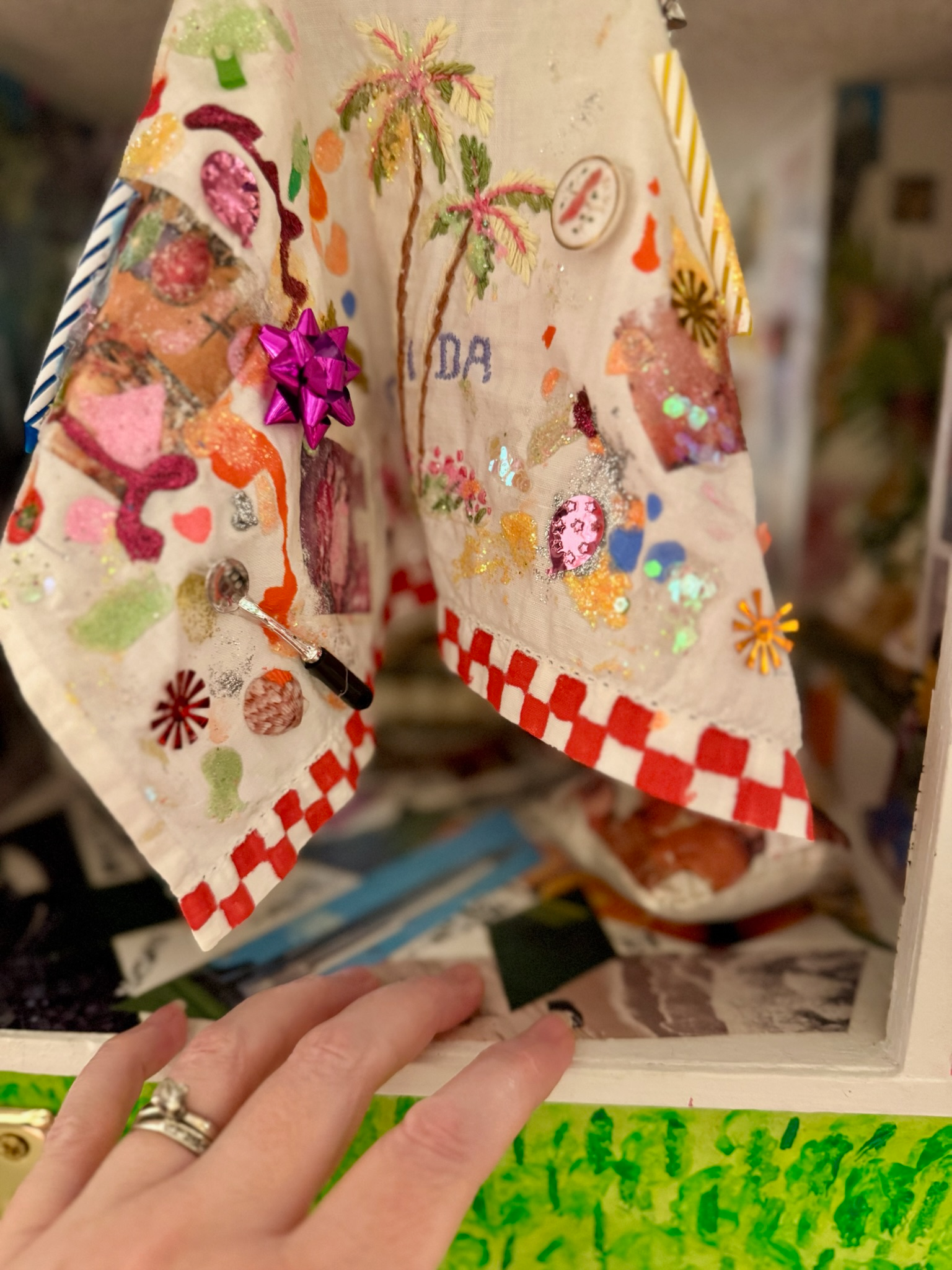
An everlasting family table is spread in this room. A vintage Florida napkin is covered in family photos and evidence of celebrations like spills, birthday candles, cake, and confetti. Because I wanted the collage on the floor to remain visible, I attached the napkin to the ceiling as a tablecloth, a sort of celebratory ghost hanging in the family space. Ceramic souvenir Florida salt and pepper shakers in the shape of seashells sit on the windowsill. A shell coffee table and a plastic-covered couch dominate the living space. My brother Matt and our great-grandfather Wesley shared a birthday and are featured in the television screen collaged on the wall. Pasted behind them are photos of my great-grandmother Rose’s hands working with ceramics. A driftwood and googly eye creation, also made by crafty Rose, is tucked underneath the stairs. On the floor is a photo pillow of me and Matt hugging each other in an easychair.
Baby Room
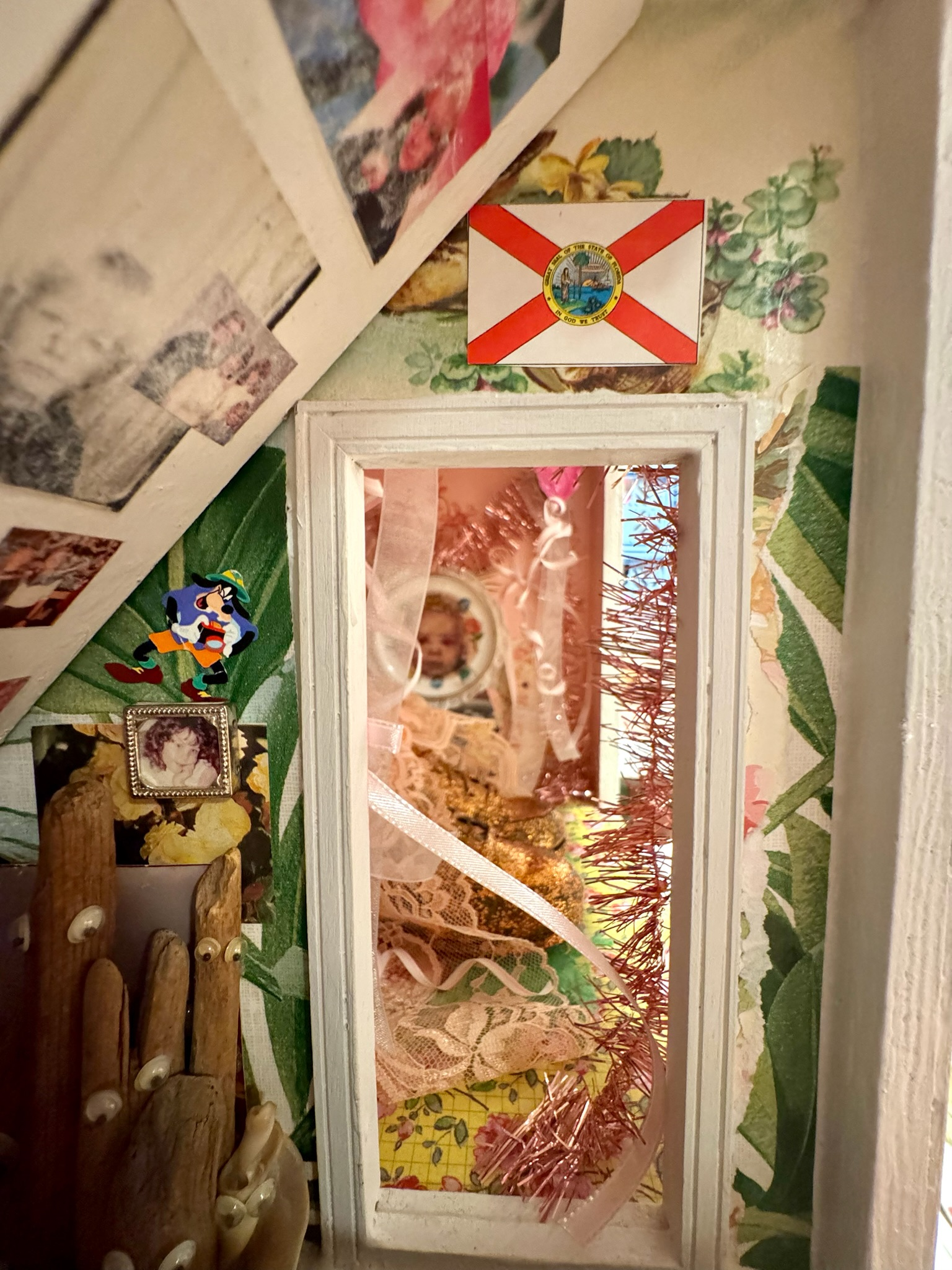
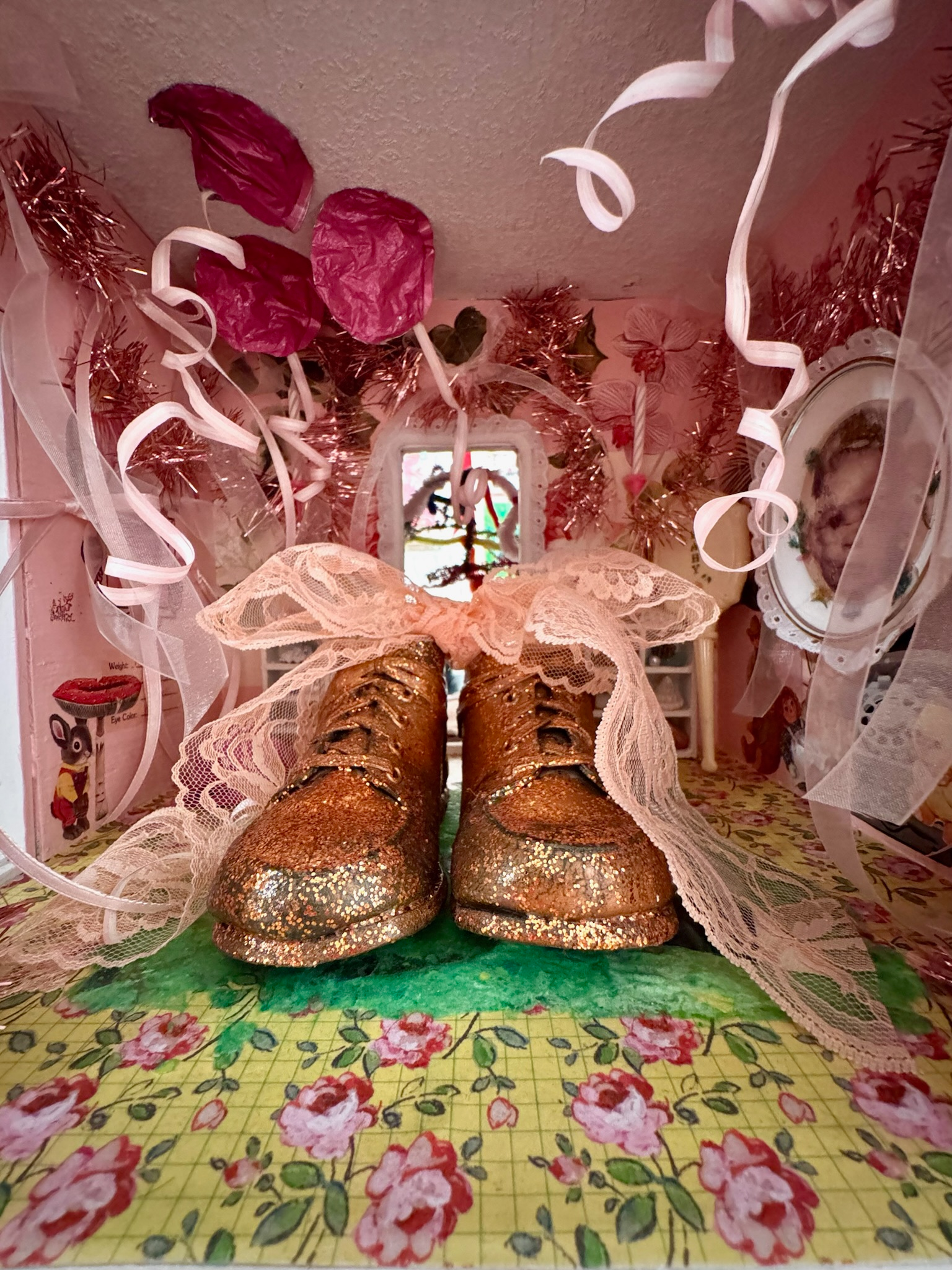
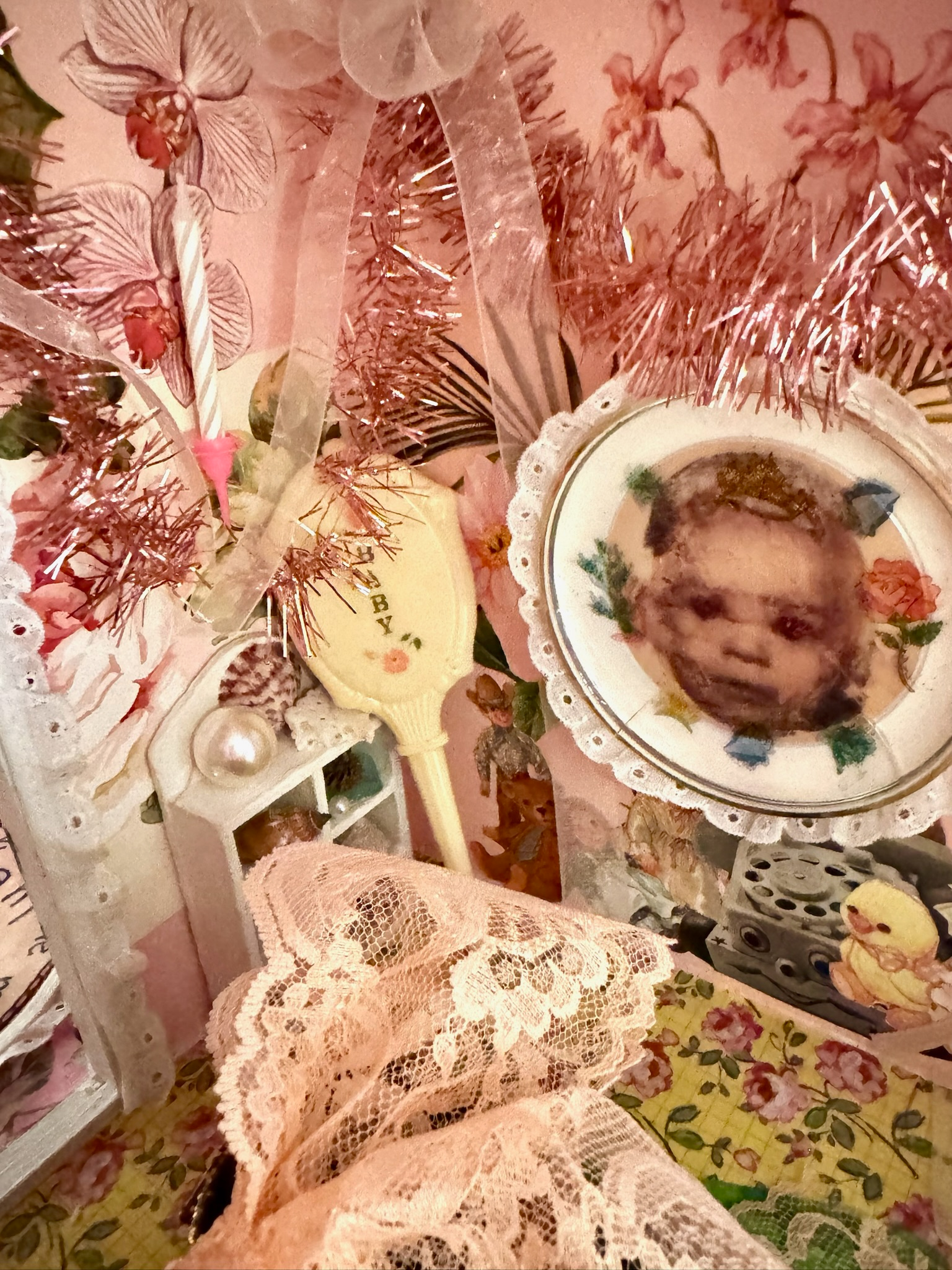
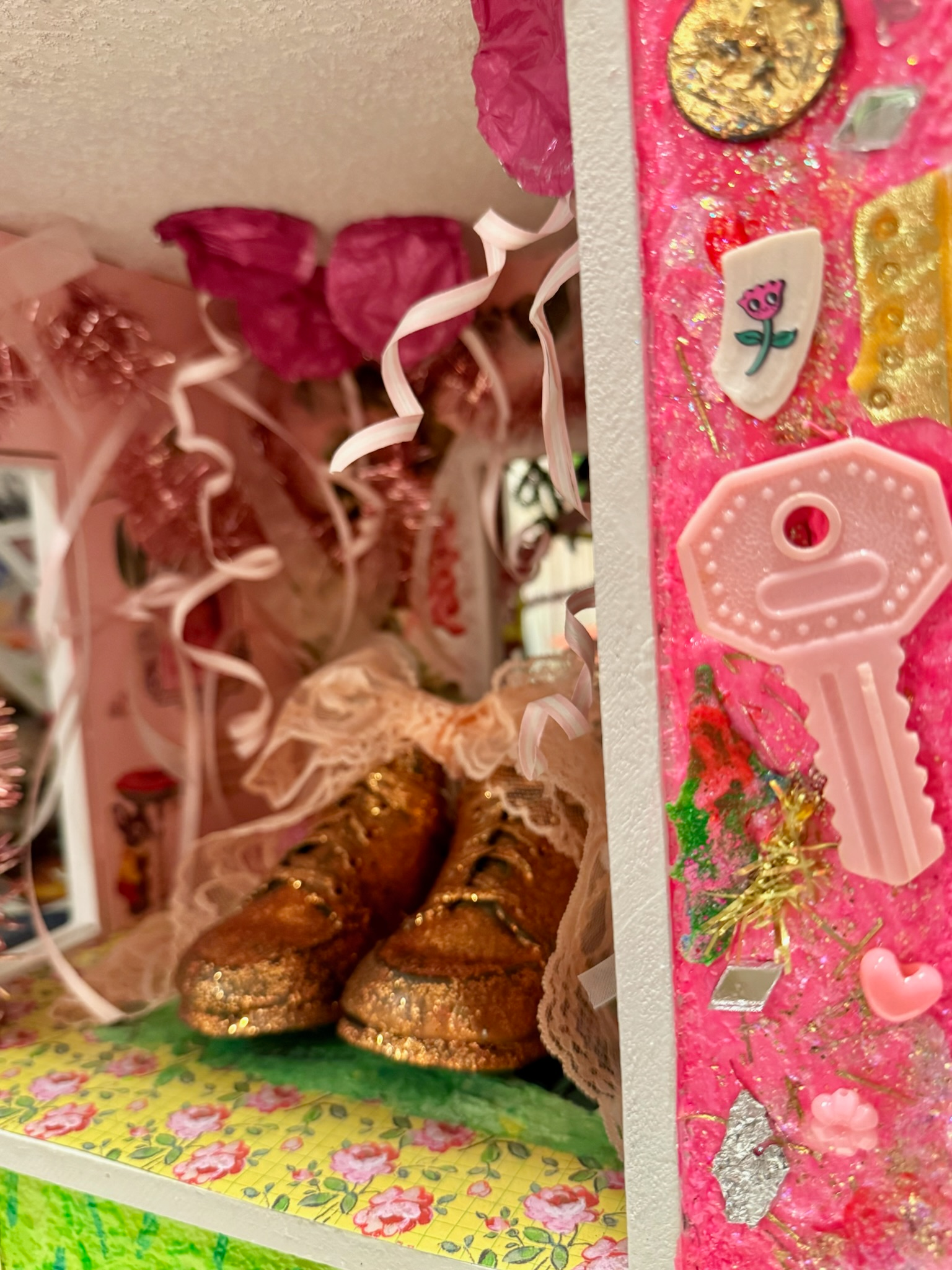
The family room holds all of us at once and outside of time. But next to it is the baby room where my own story begins. I was born Elizabeth Angela Gordon on August 12, 1979 to 18-year-old first-time parents, Mark and Angela. This room celebrates my birth with precious mementos saved by my parents: bronze spray-painted baby shoes, a baby brush, and a small plastic dish with my first photo on it. The floor is layered with floral prints and green handmade paper. My bronze baby shoes (now with bronze glitter!) take up the center of the room. The pink walls are papered with pictures of me, flowers, toys, and cartoons. Ribbons, lace, tinsel, and mylar balloons sweetly clutter the space, as if a baby shower just ended. Birthday candle sconces and bookshelves filled with shells and pearls flank the back doorway that leads to the girlhood room.
Girlhood Room
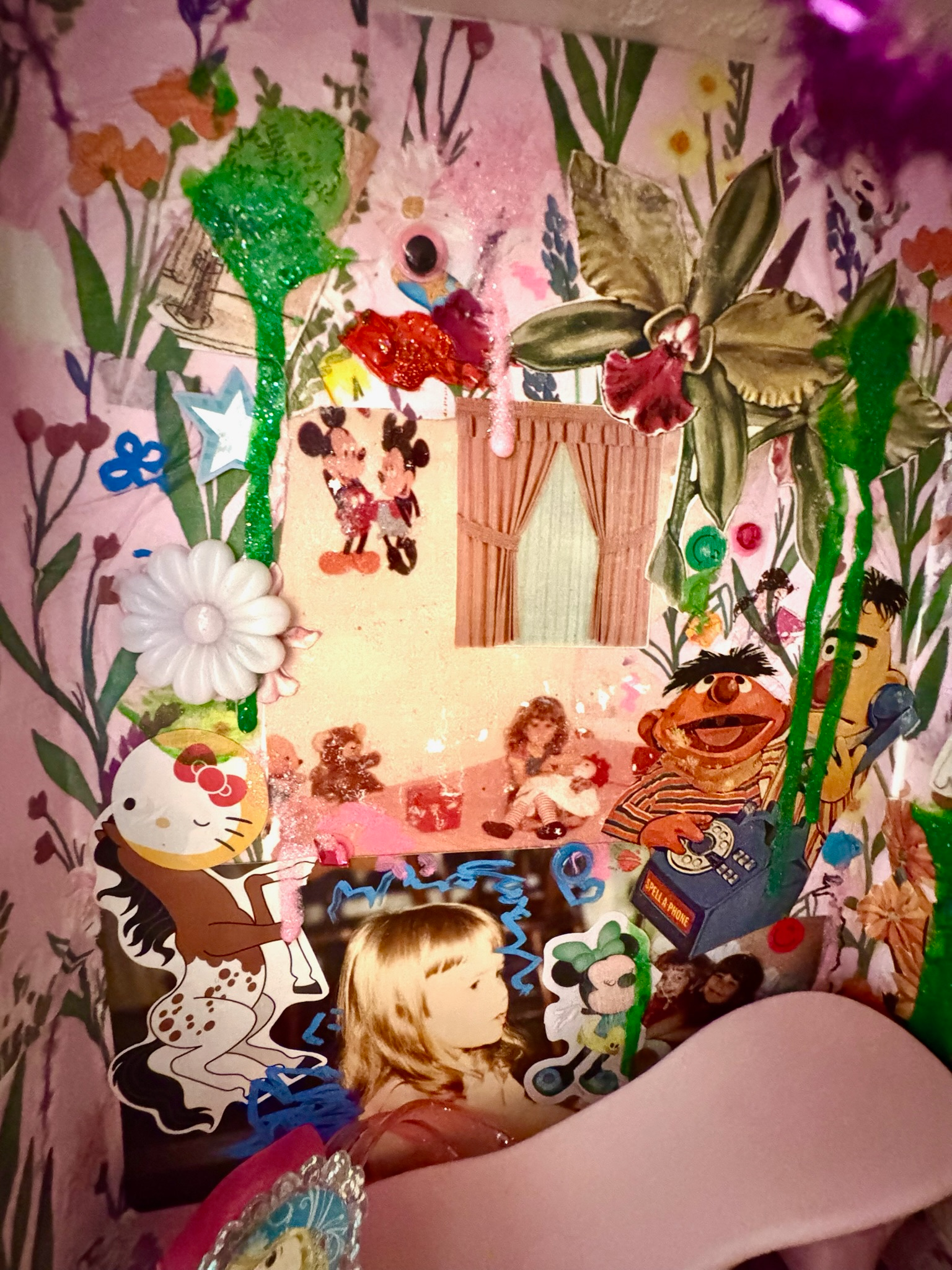
The girlhood room recalls a time of innocence — slumber parties, art camp, playgrounds, Slip n’ Slide in the backyard, summers at the beach, and a new little brother, Matt. The walls are playfully covered in photographs of me in my girlhood room, family members when they were young, Disney princesses, flowers, cartoon characters, stickers, and drawings. Globs of green glitter that remind me of Nickelodeon slime drip down the walls. My Brownie troupe numbers and a family photo pendant hang above the doorway. Back then, my Barbies resided in a huge wooden dollhouse built by my parents and decorated with curtains and linens sewed by my mom. A photo on the back wall shows me and my dad with that same childhood dollhouse!
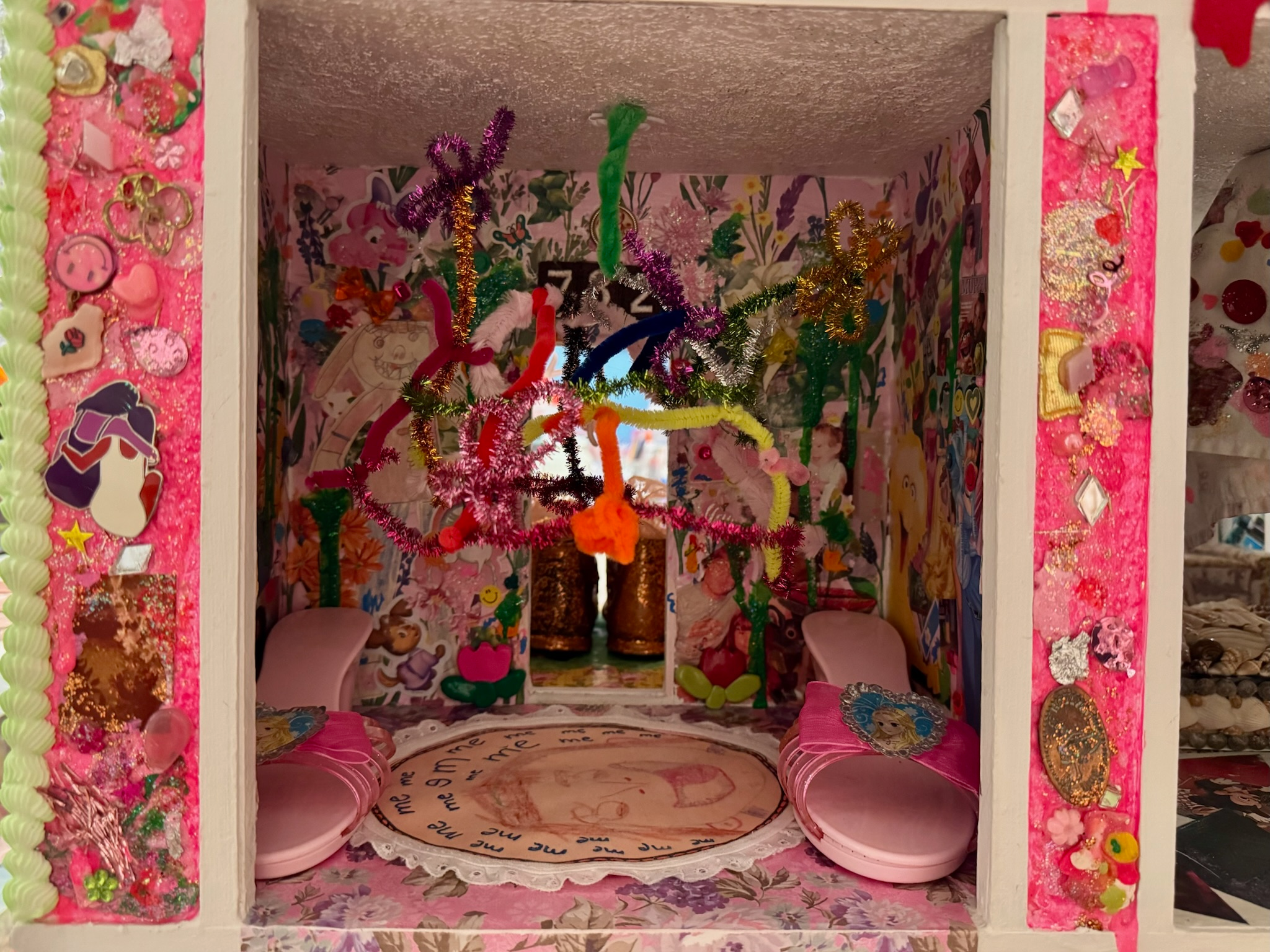
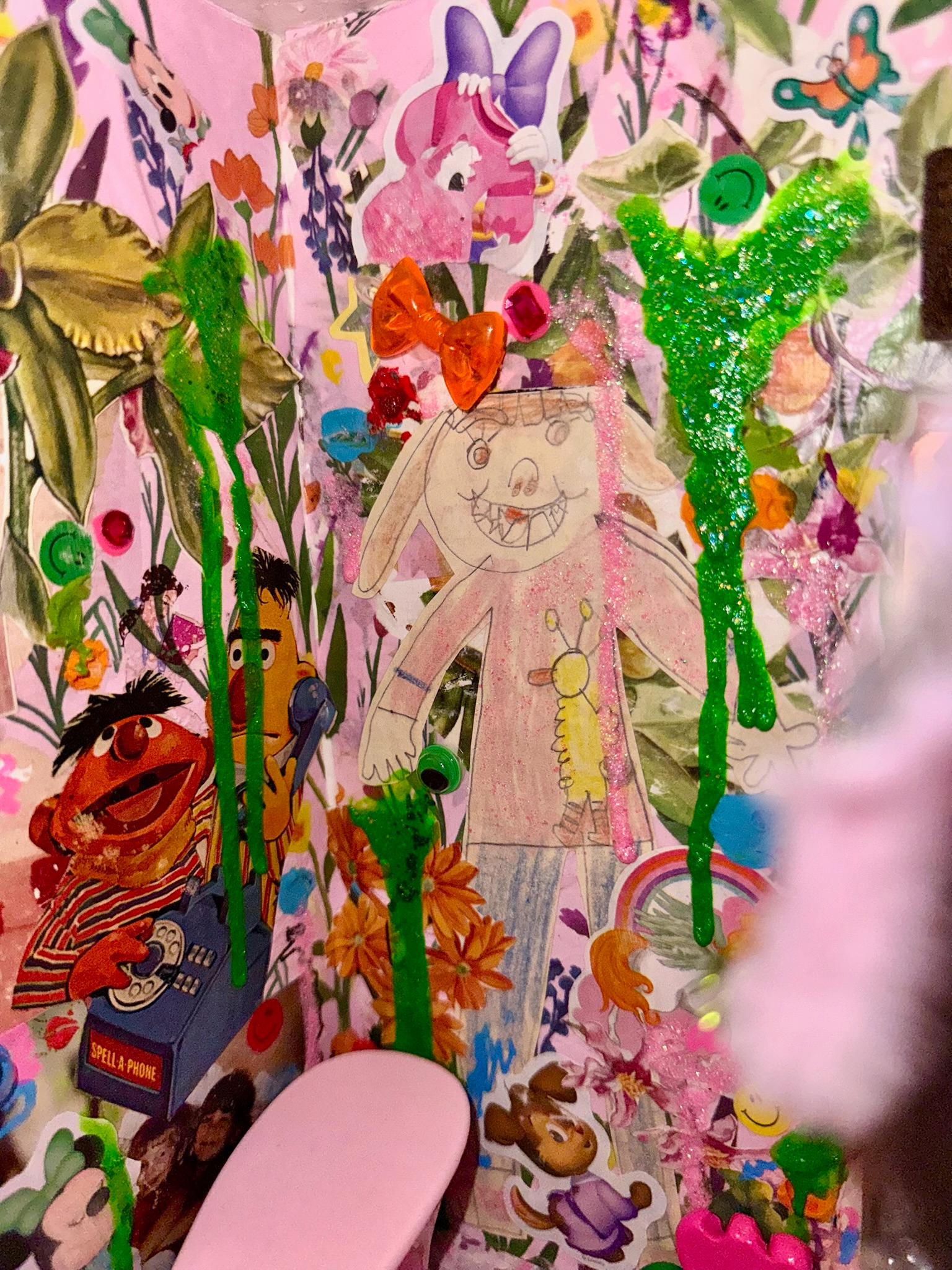
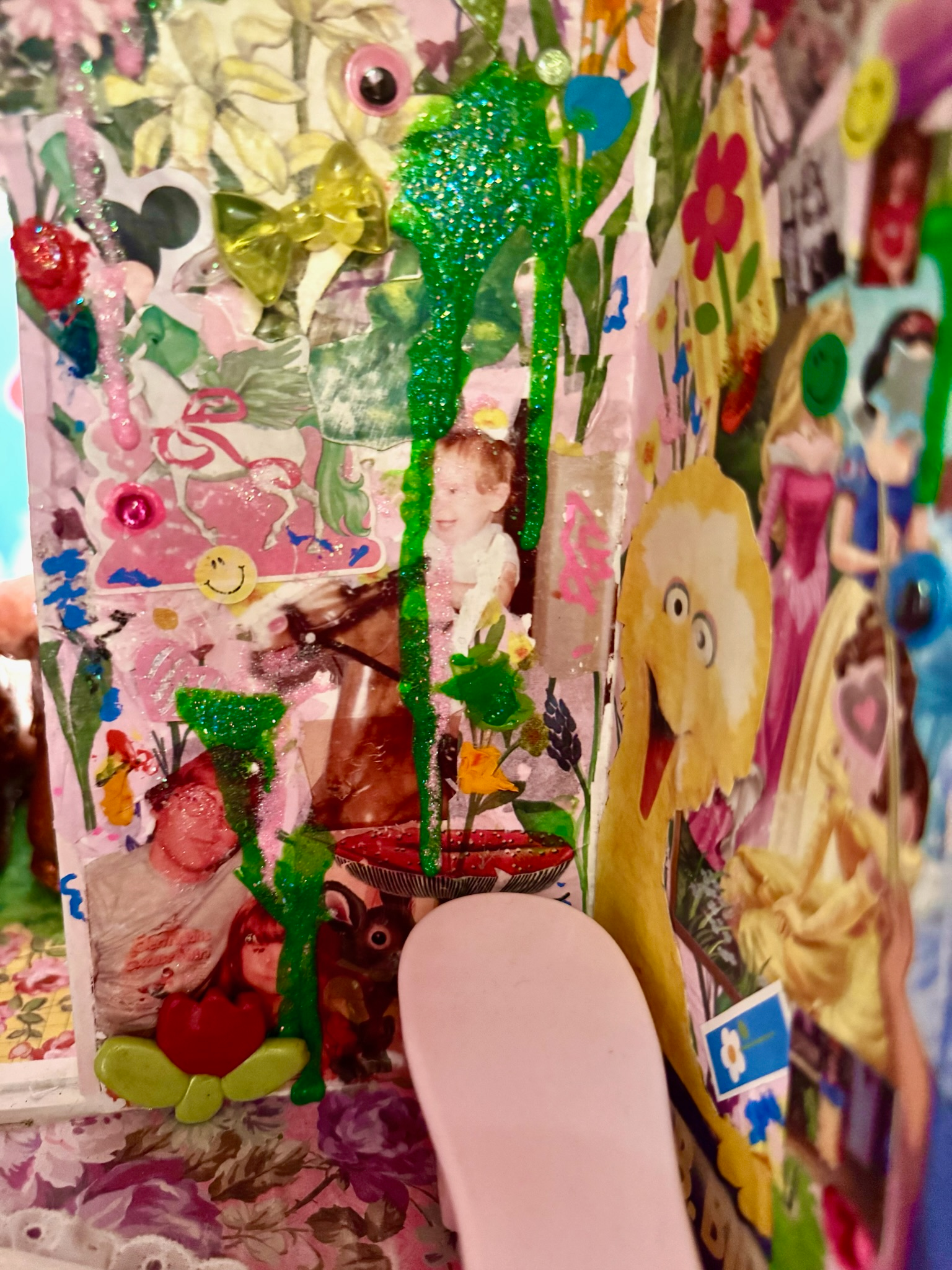
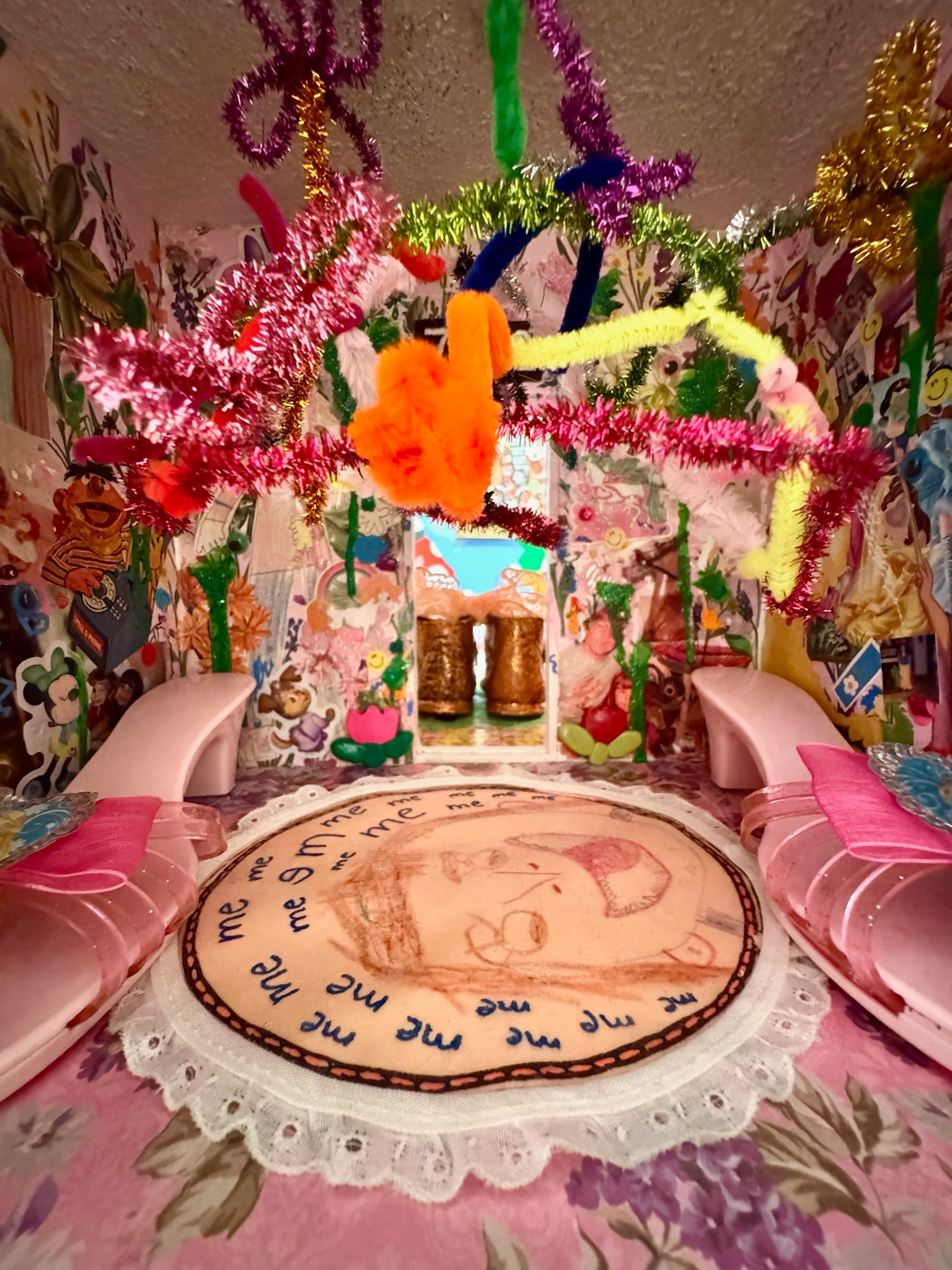
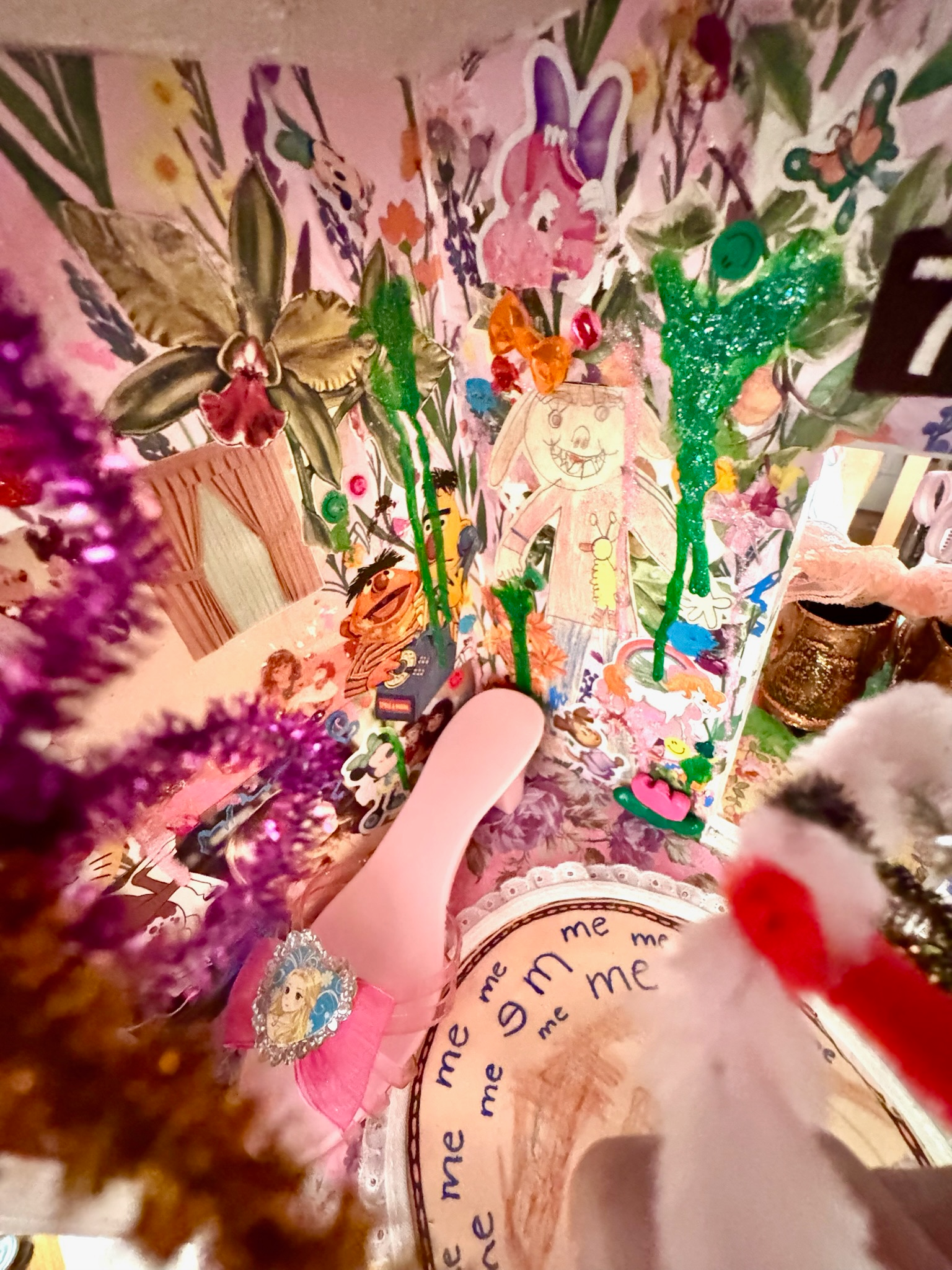
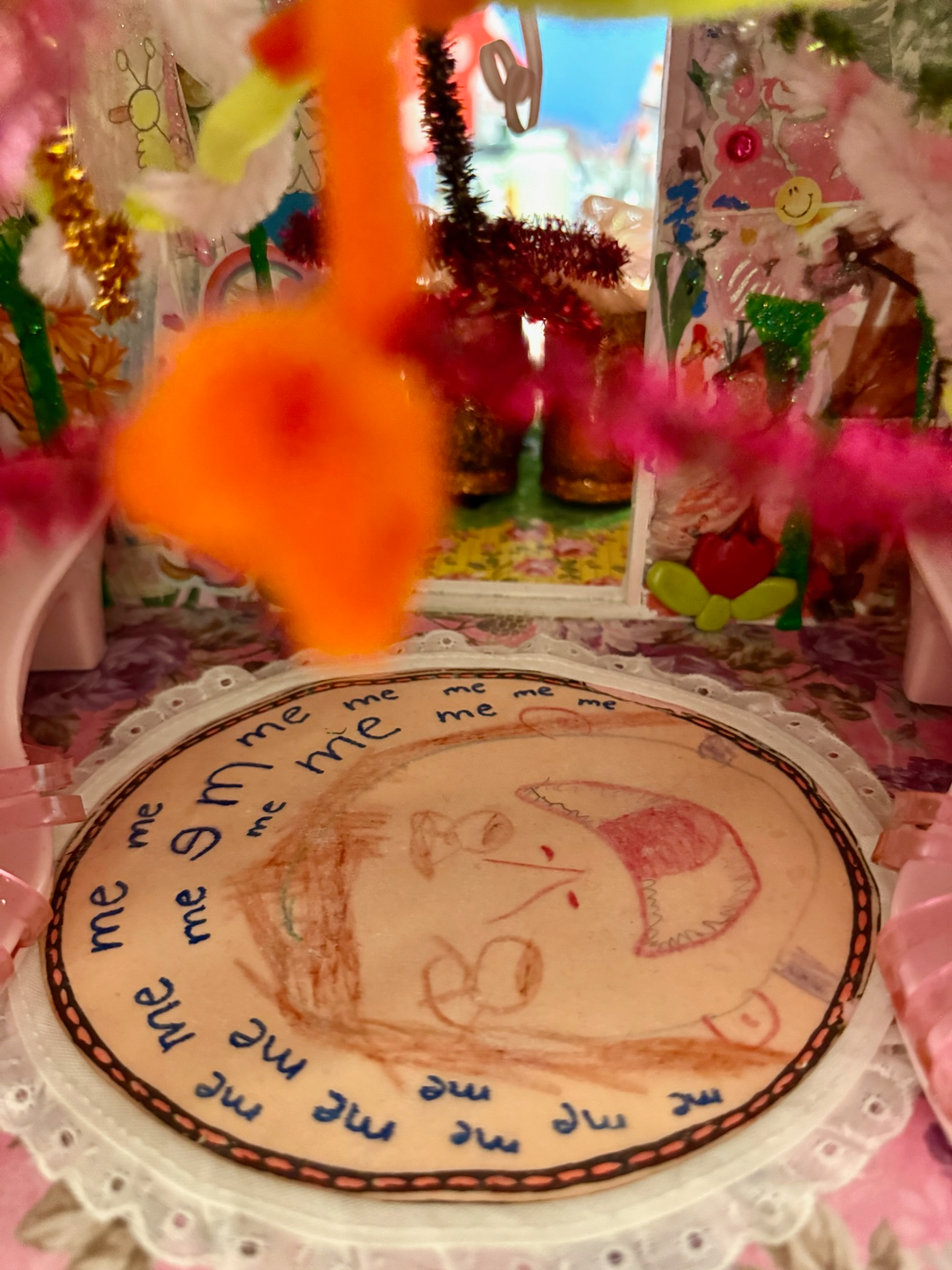
The circular drawing on the floor is an embellished reproduction of a self-portrait I drew at age seven. The plastic high-heel shoes on each side exhibit the feminine play girls are taught to perform from an early age. The colorful, shiny pipe cleaner creation hanging from the ceiling represents the cage that I felt descended on me as I began to age out of girlhood and into tweendom.
Hallway
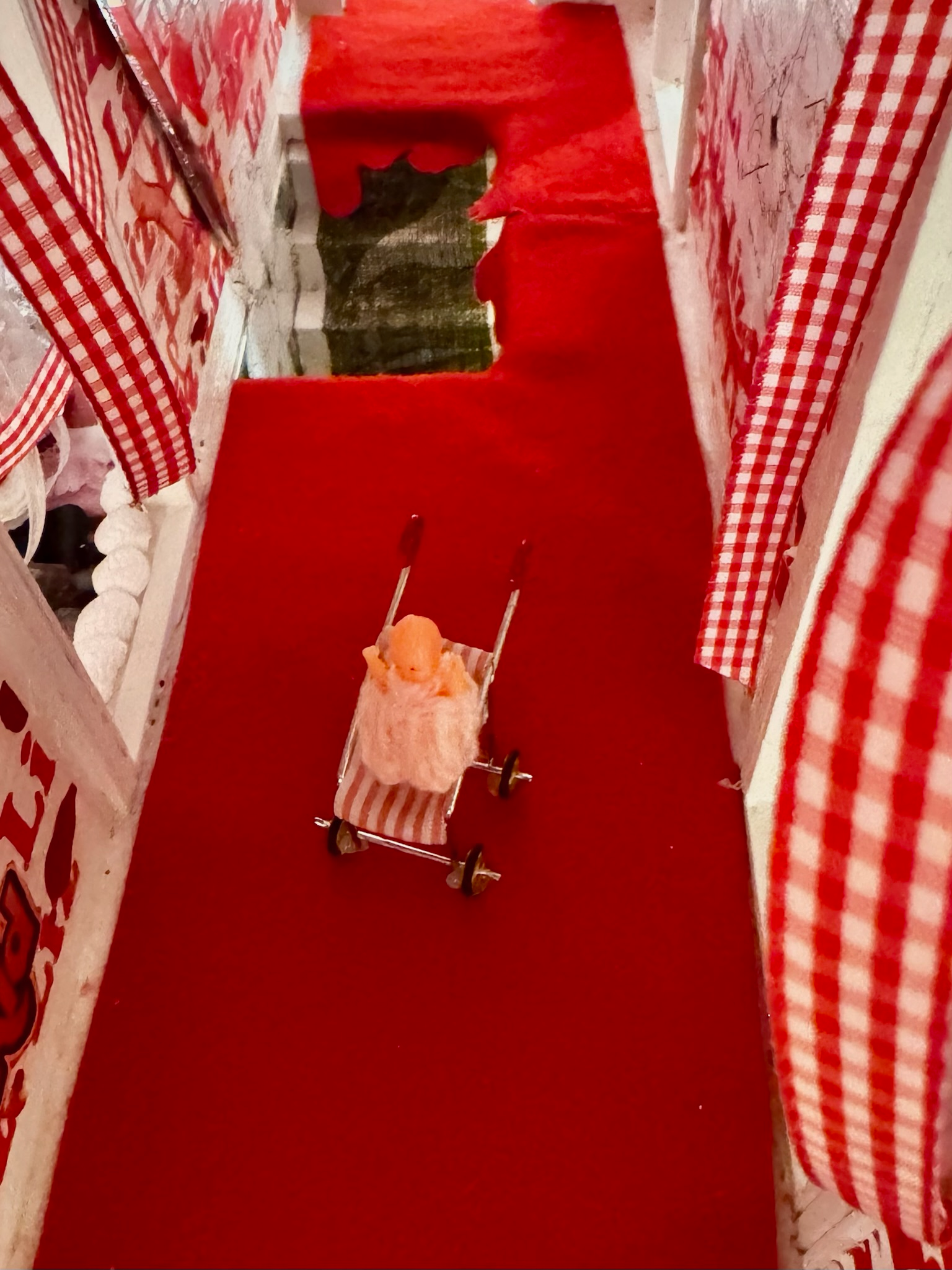
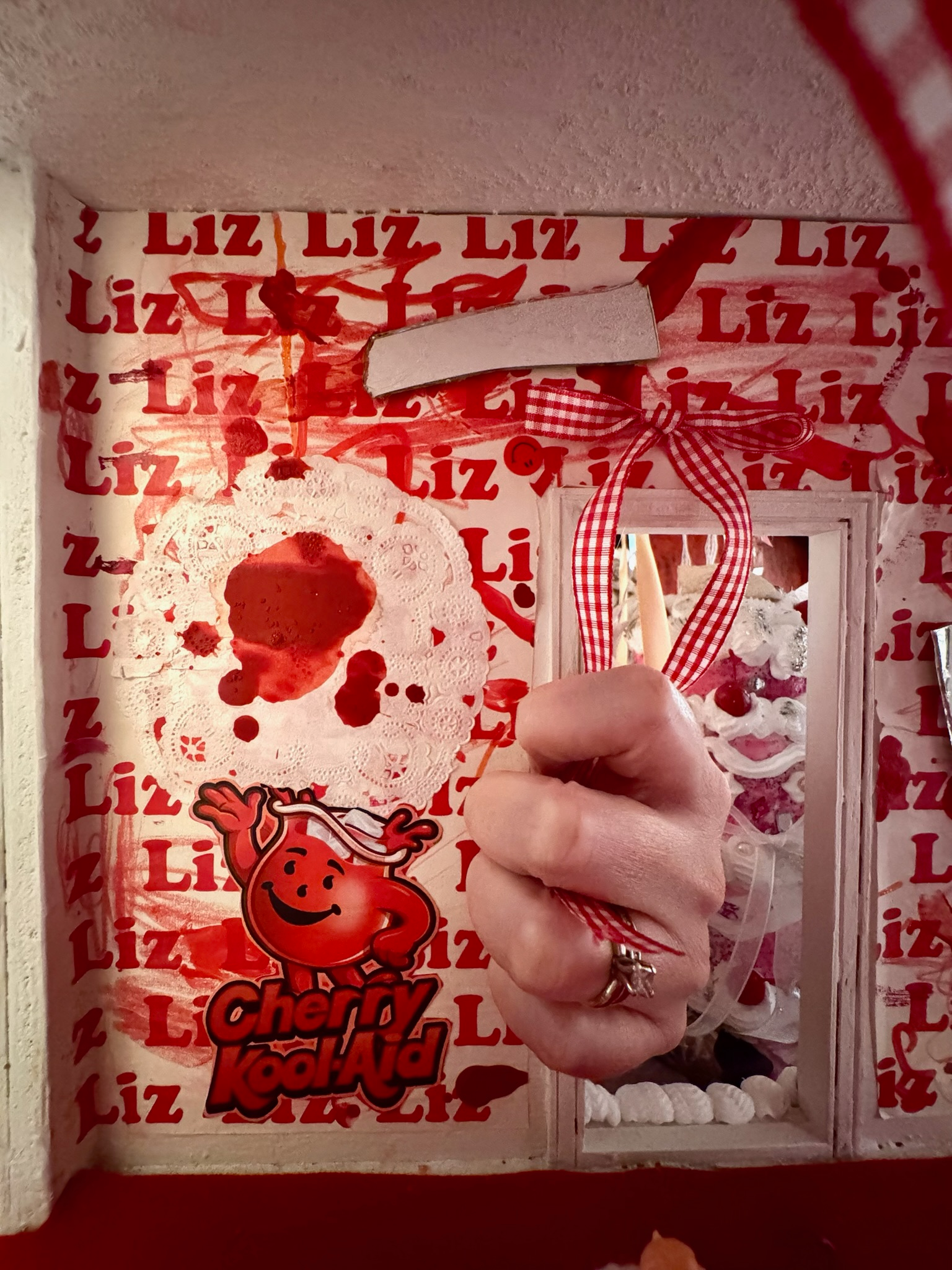
Back through the family room and up the stairs is a hallway that runs through the middle of the dollhouse. It serves to simulate the dramatic transition from girl to teenager — hormones, menstruation, self-surveillance, loss of innocence. I started to notice being looked at and wondered if I was inviting the attention. On the walls of the hallway are shards of mirror and educational diagrams of orchids, representing the fragmented information that filtered through school, friends, and pre-internet media. Novelty “LIZ” wrapping paper gifted to me by my grandmother Lana sometime in the 90s finally found its purpose as wallpaper for this hallway. A toy baby girl in a stroller sits alone in the hallway, waiting. Red scribbles and blotches on the walls, red felt lining the floor — all of it conjures menstruation, the "magical" transition to womanhood.
Teen Room
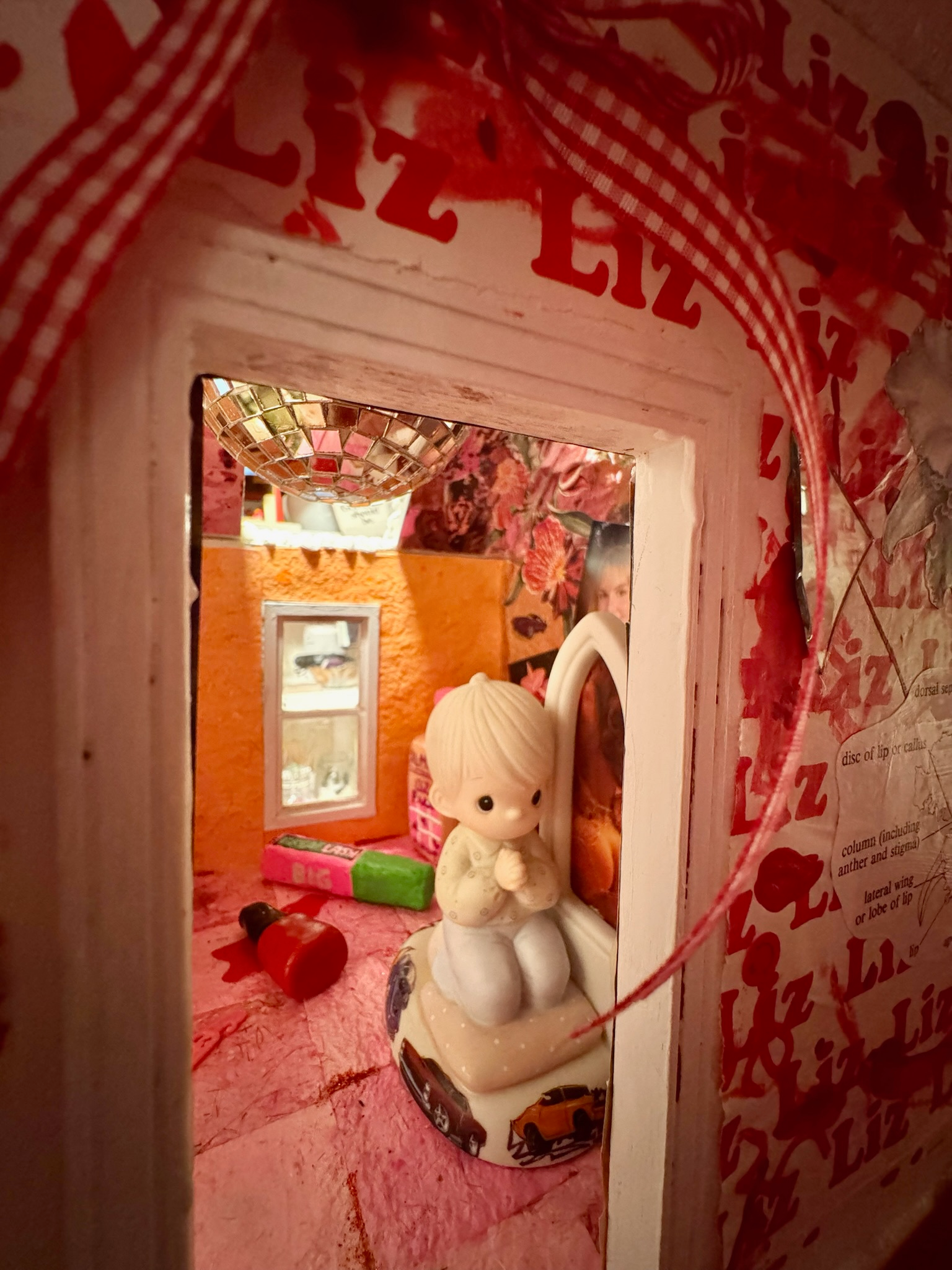
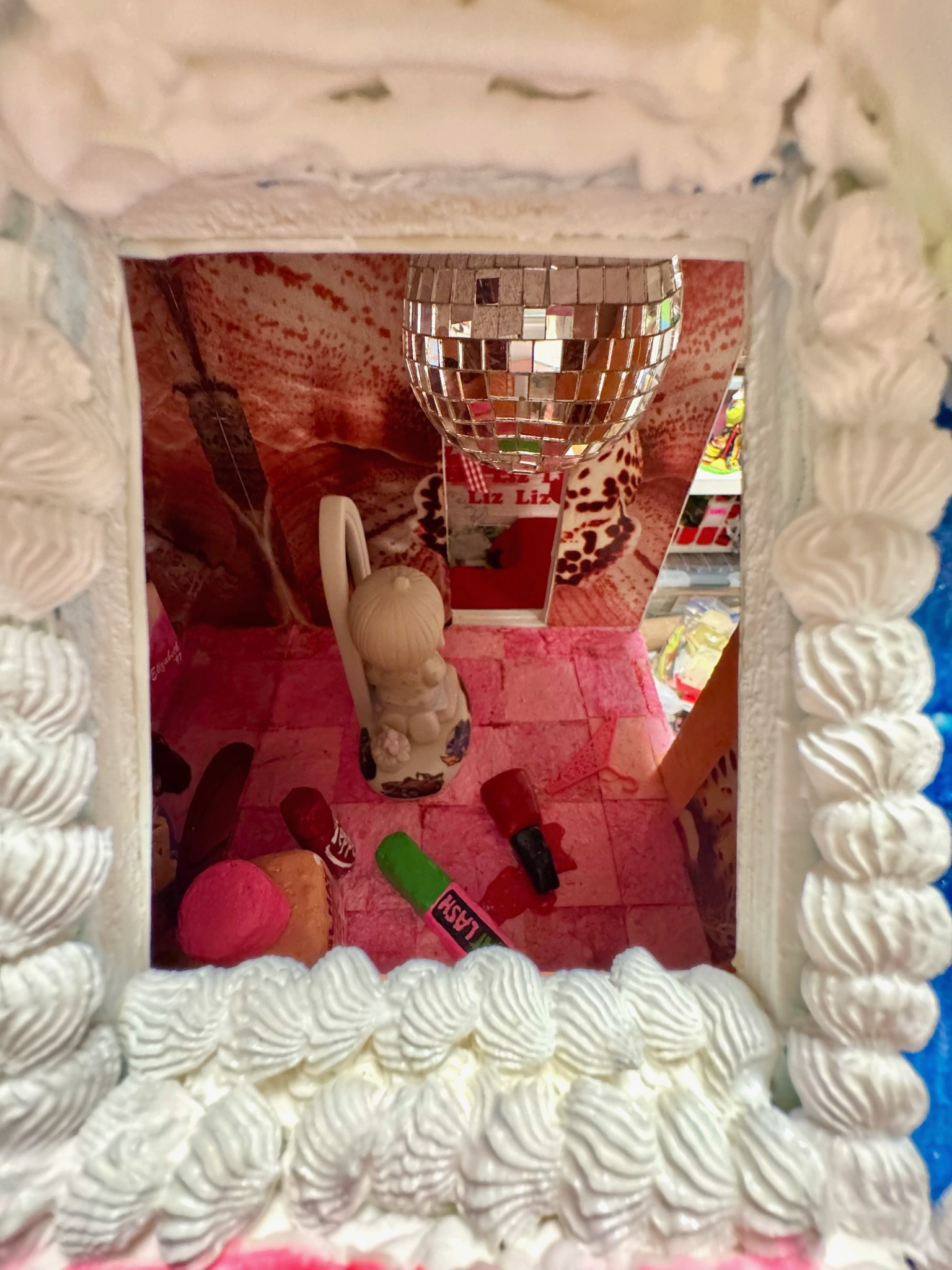
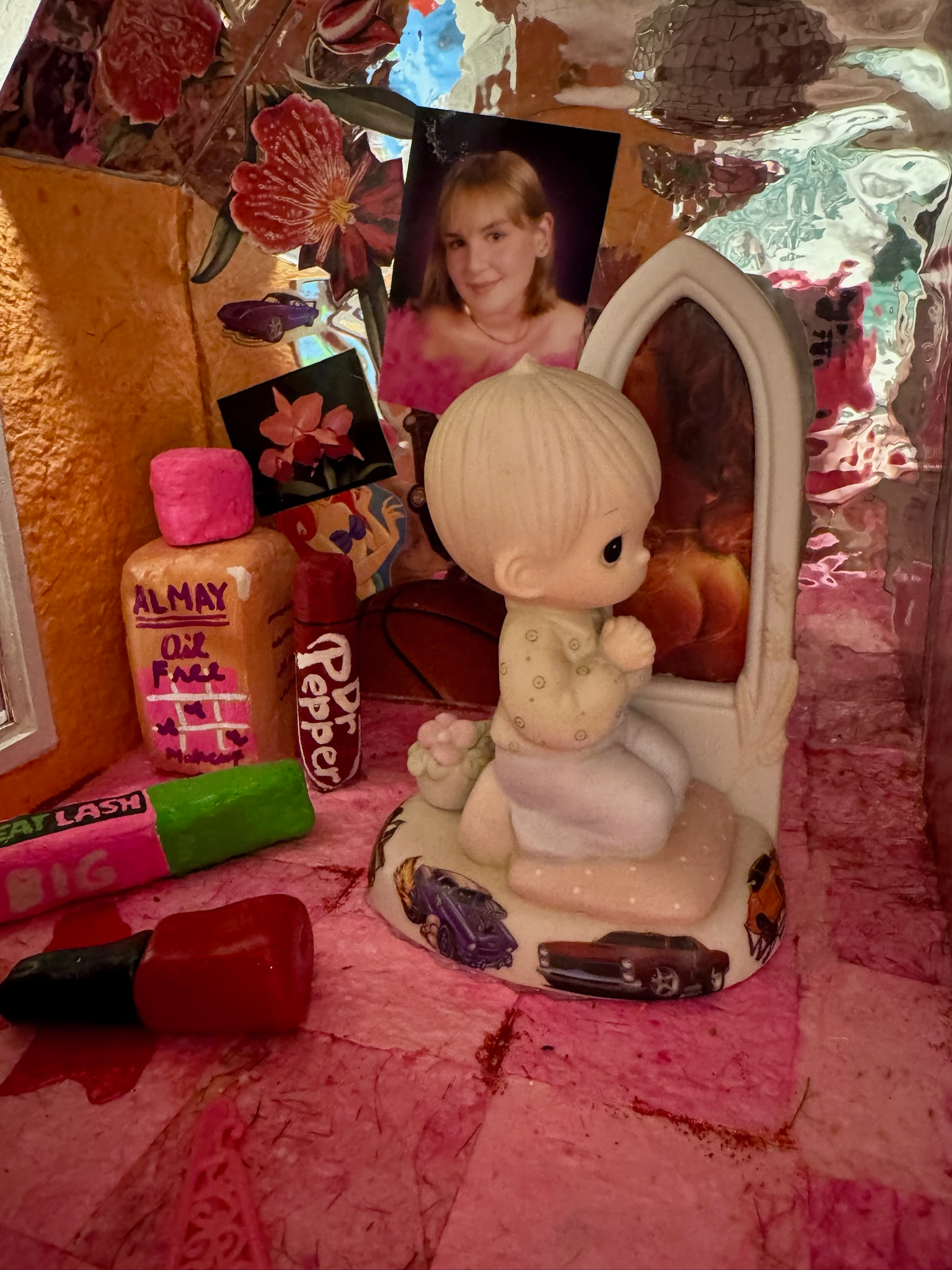
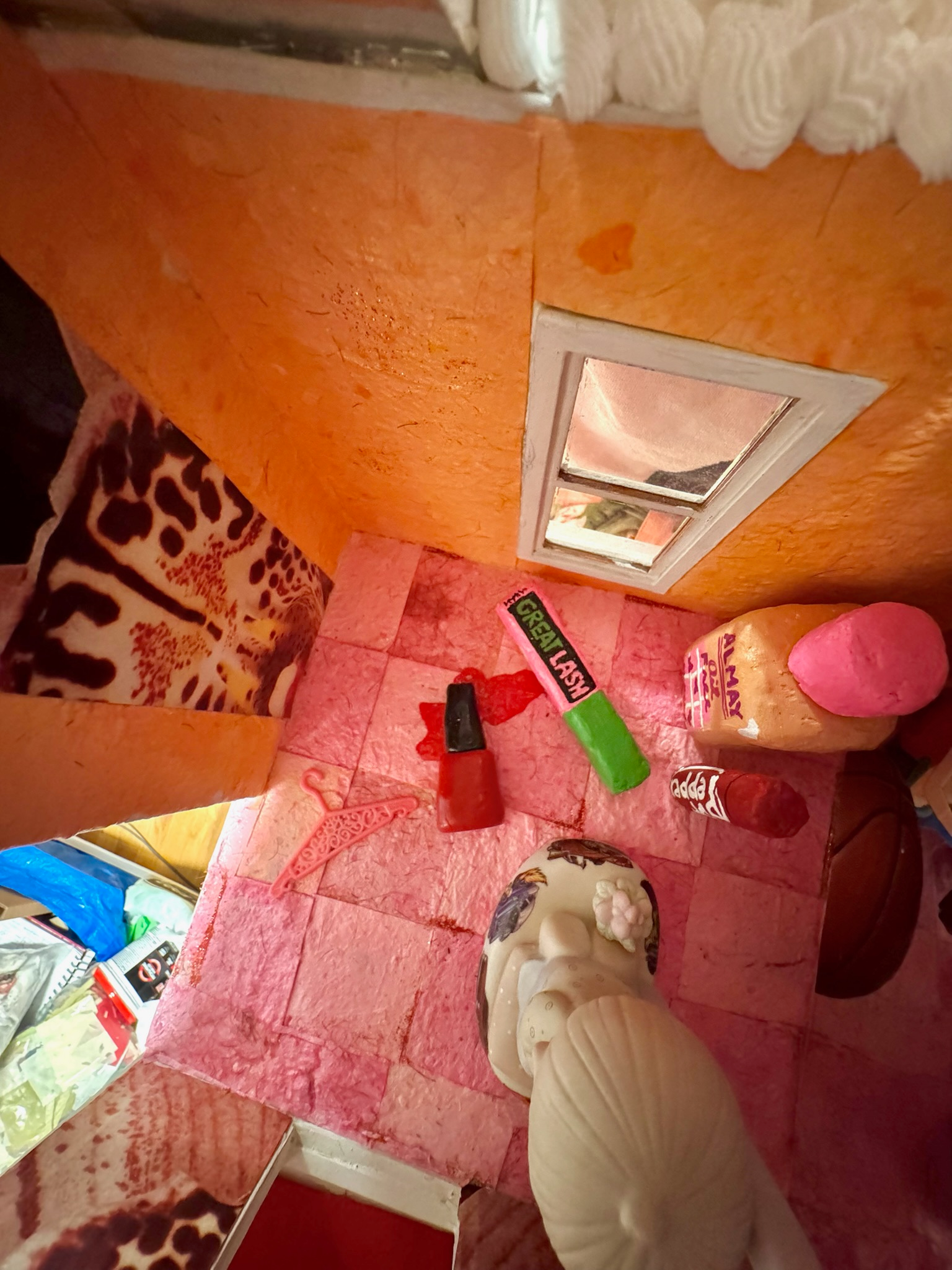
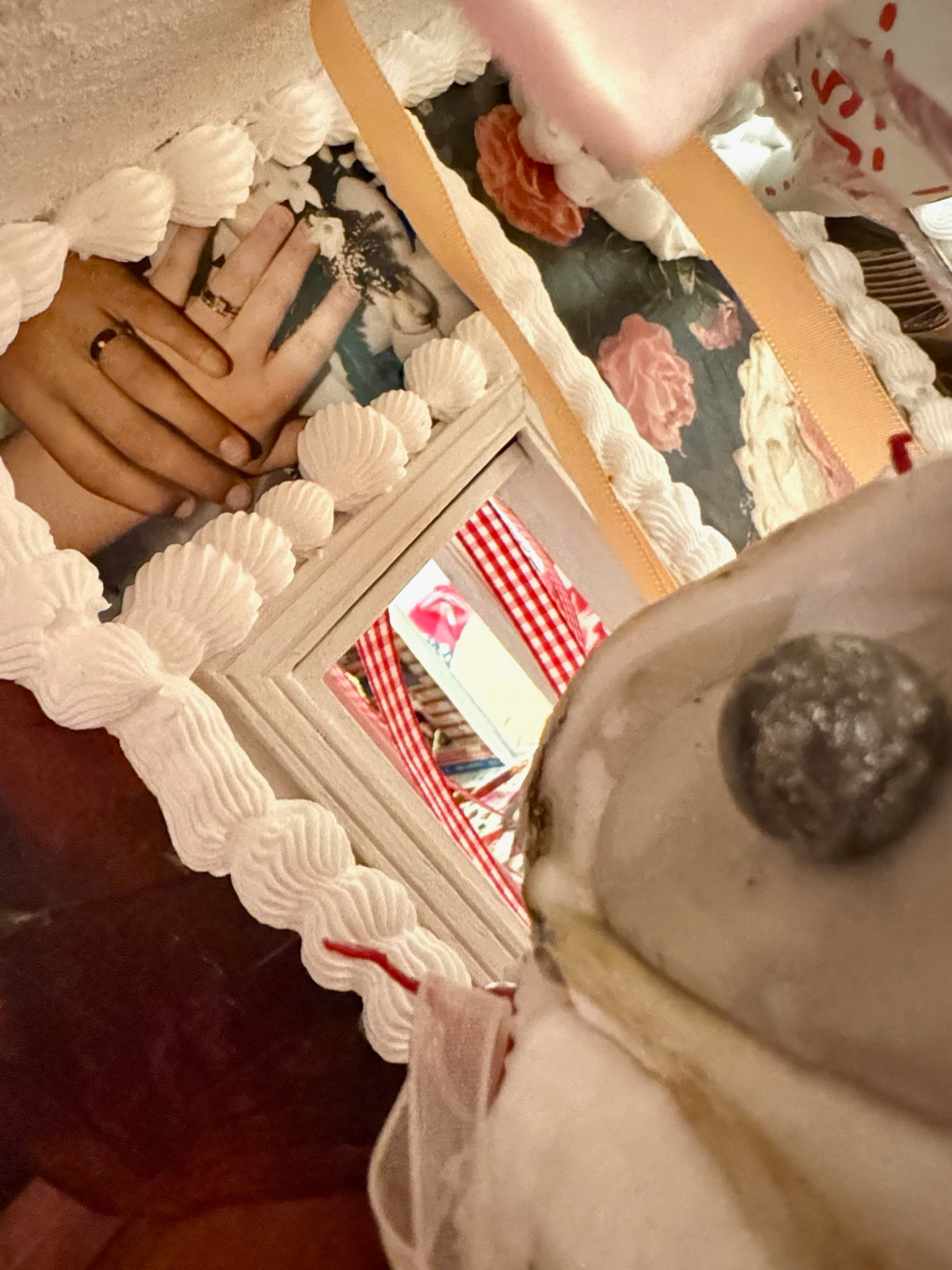
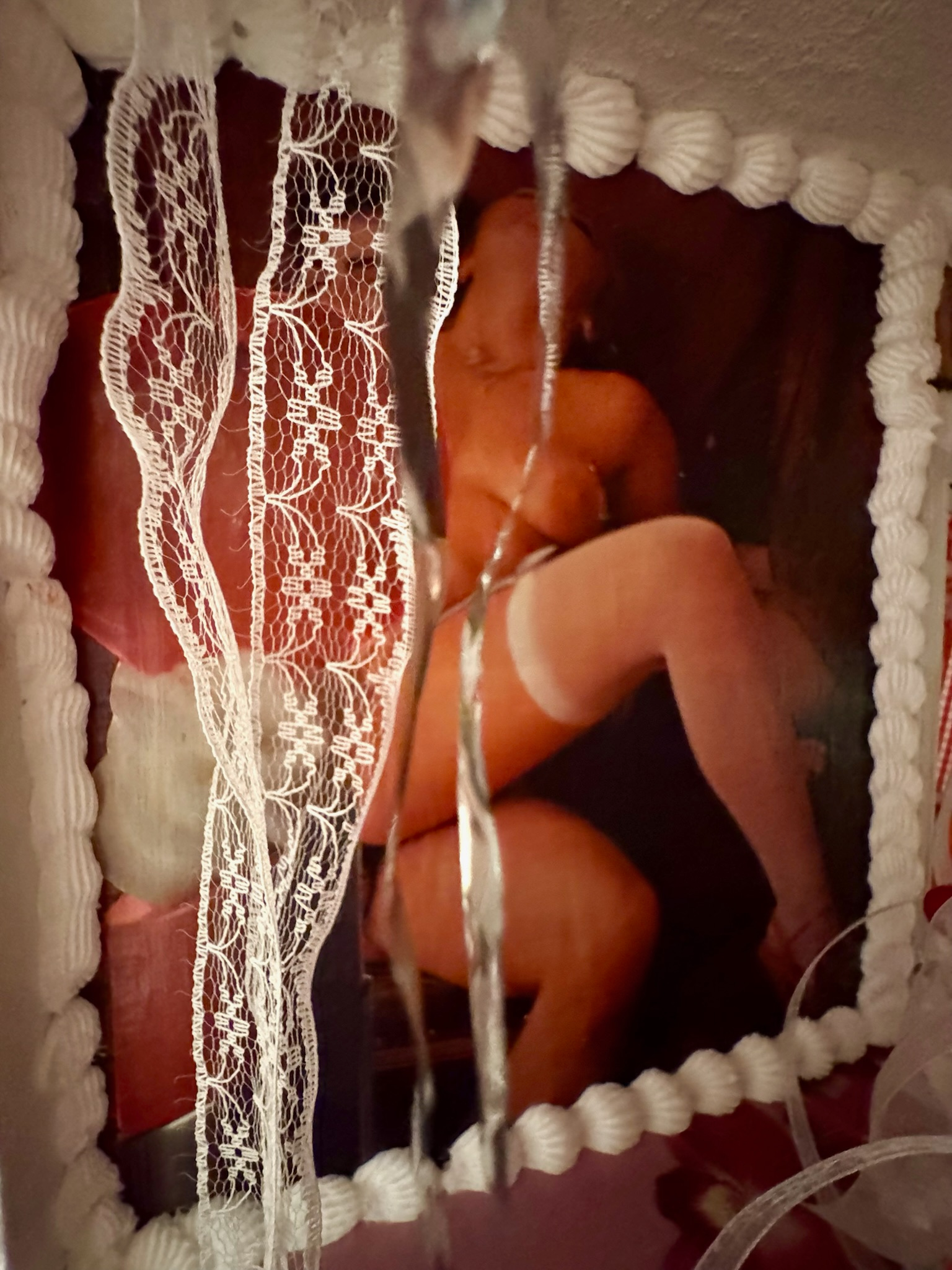
Through the doorway plastered with a giant orchid is the teen room. Mirrored walls and a mirrored disco ball on the ceiling represent vanity and self-surveillance. The Evangelical church I was brought up in encouraged purity from sin through physical and mental self-surveillance. This room is also the place where viewers can see themselves reflected back the most. The remaining walls and floor are lined with handmade pink and peach paper I created to look like skin. The left side of the room contains large handmade sculptures of classic 90s makeup. On the right side of the room is a vintage Precious Moments figurine altered with a Playboy image and covered in temporary tattoos of muscle cars. All of these elements represent the sexual charge and confusion of this age. Self-surveillance really kicks in and while it can be fun to experiment with new looks — and being looked at — a creeping impulse for perfection set in for me during those years. It kind of feels like all I did was listen to music, look at magazines, and scrutinize myself in the mirror. Underneath all of it was patriarchal purity culture.
Marriage Room
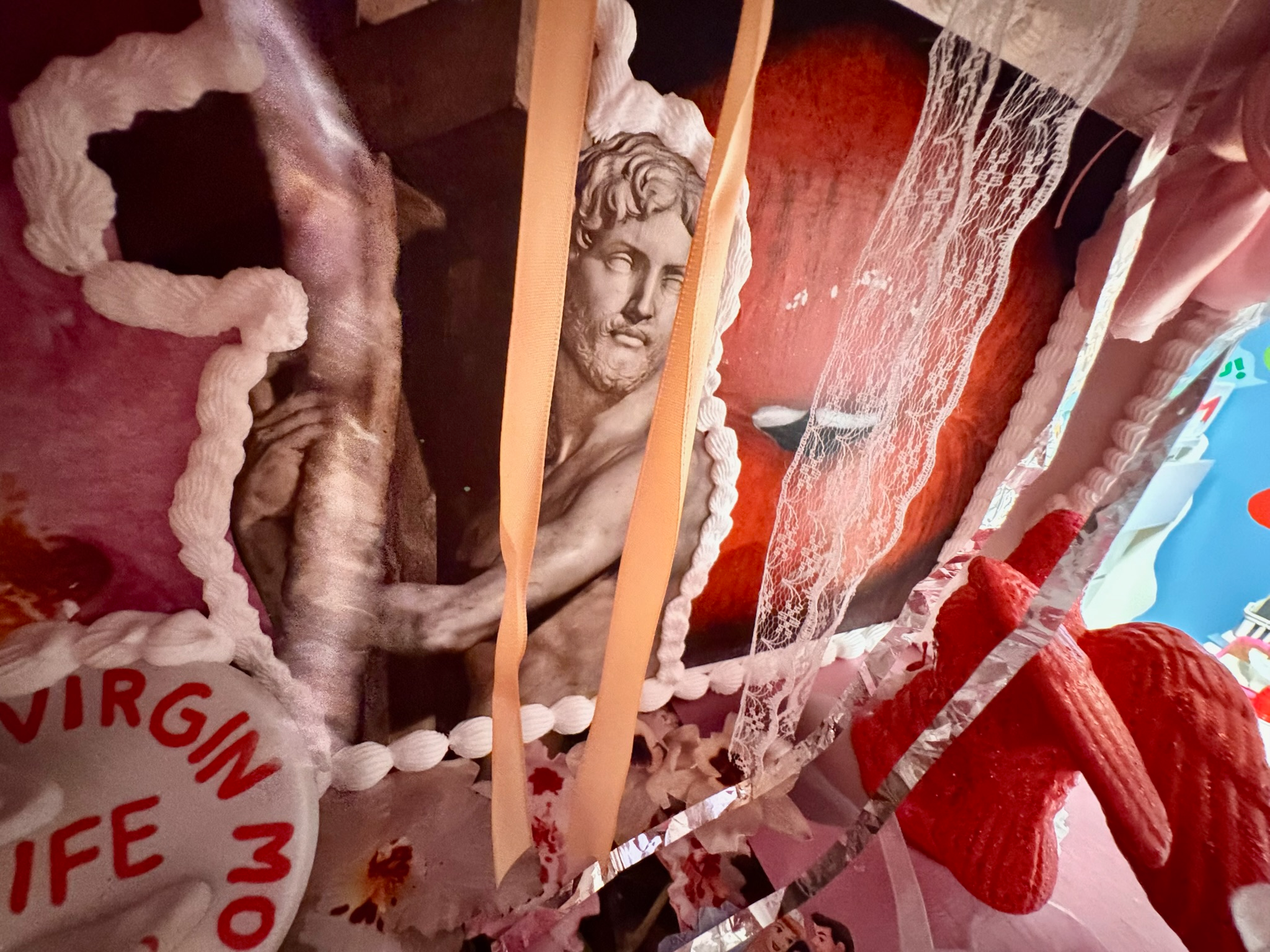
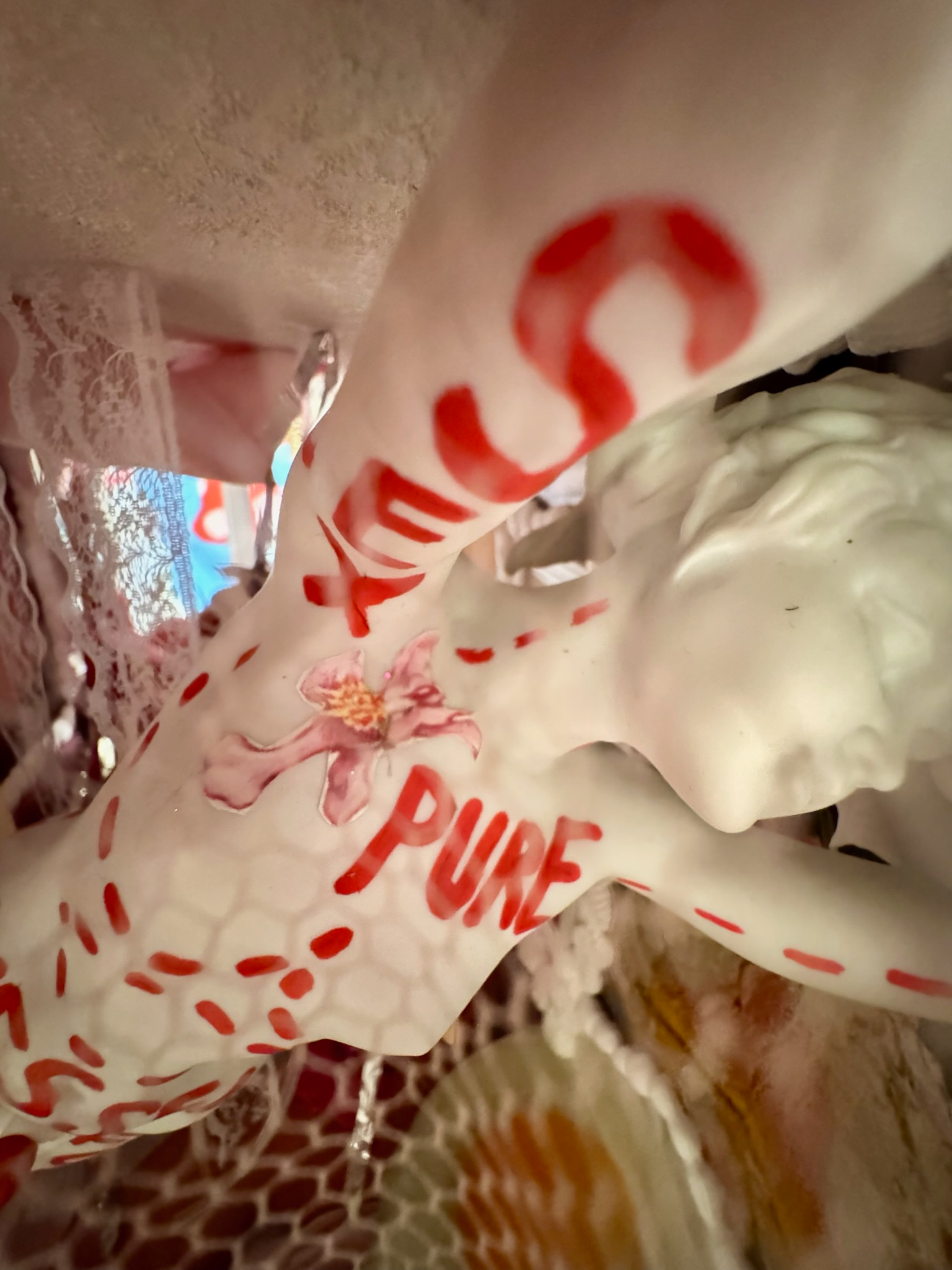
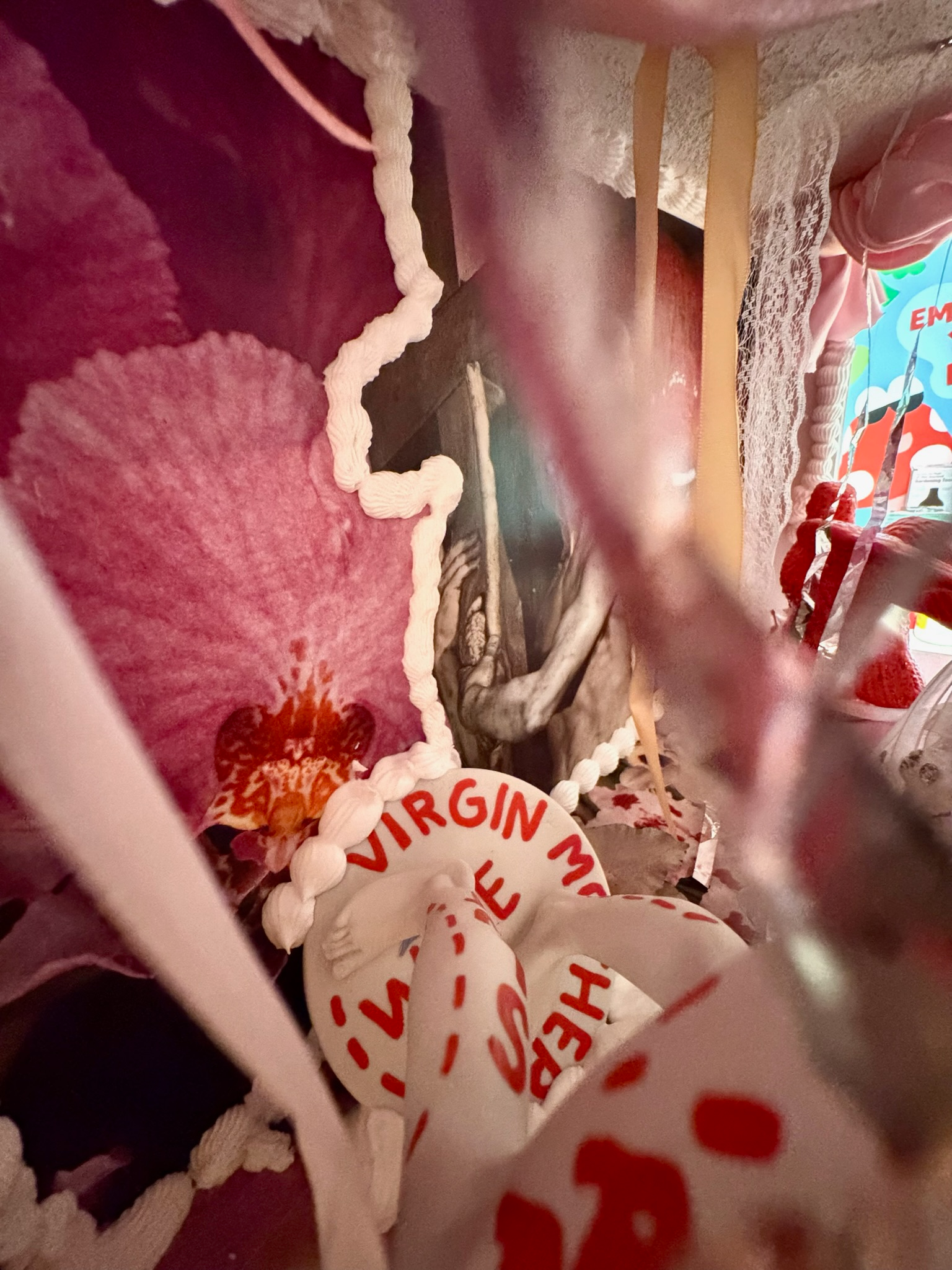
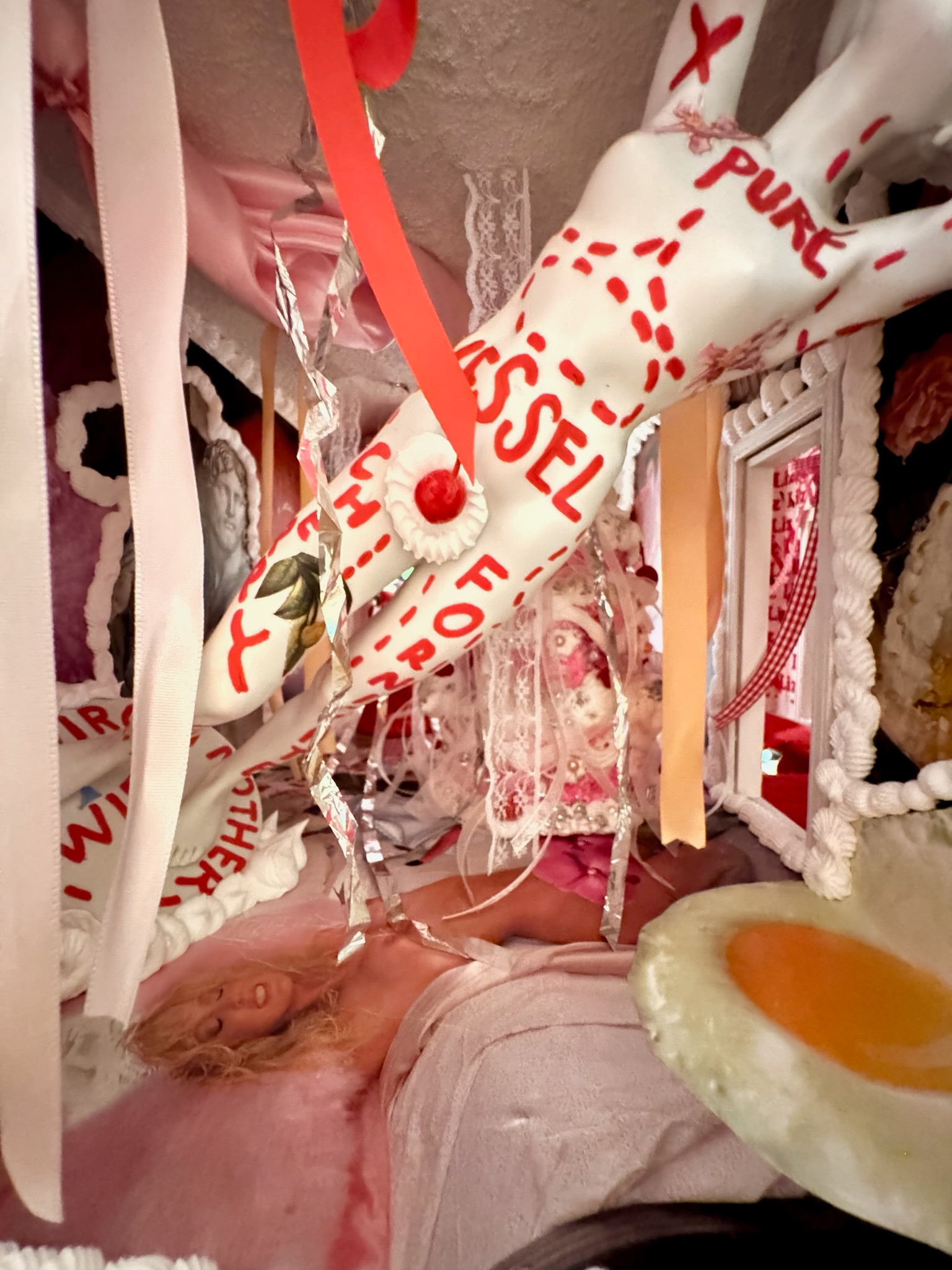
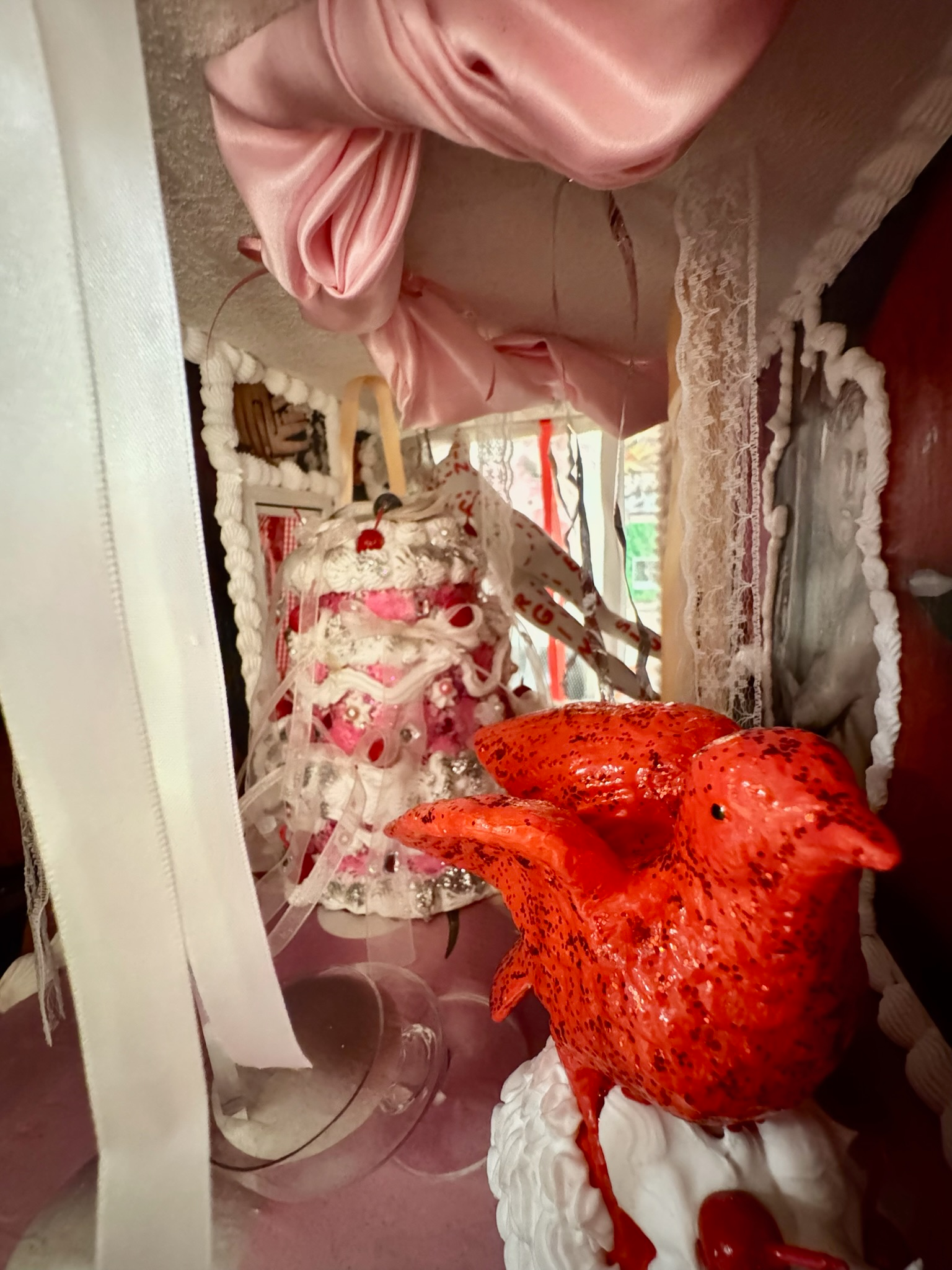
Around the other side of the dollhouse is a room covered by a white veil. Lift the veil to peek into a room of contradicting visuals. The walls are a collage of vintage Playboy spreads, wedding photos, orchids, lips, eggs, oysters, cherries, and religious imagery. And separating each of these images are neat lines of white scalloped frosting. The first thing you see on this side of the room is a white statue of a naked young woman — too tall for the space, but jammed anyway. On her body, in red, I have written words tossed around within purity culture: pure, vessel, wife, virgin, mother, fornication, slut. The statue also sports a flower tattoo, plastic surgery outlines, and frosting topped with a cherry between her legs, referencing the weighted importance given to beauty and virginity. Behind her is a three-layered cake painted Barbie pink and smothered with more frosting and cherries. On top of the cake sits a polymer clay oyster and pearl I shaped inside of a real oyster shell.
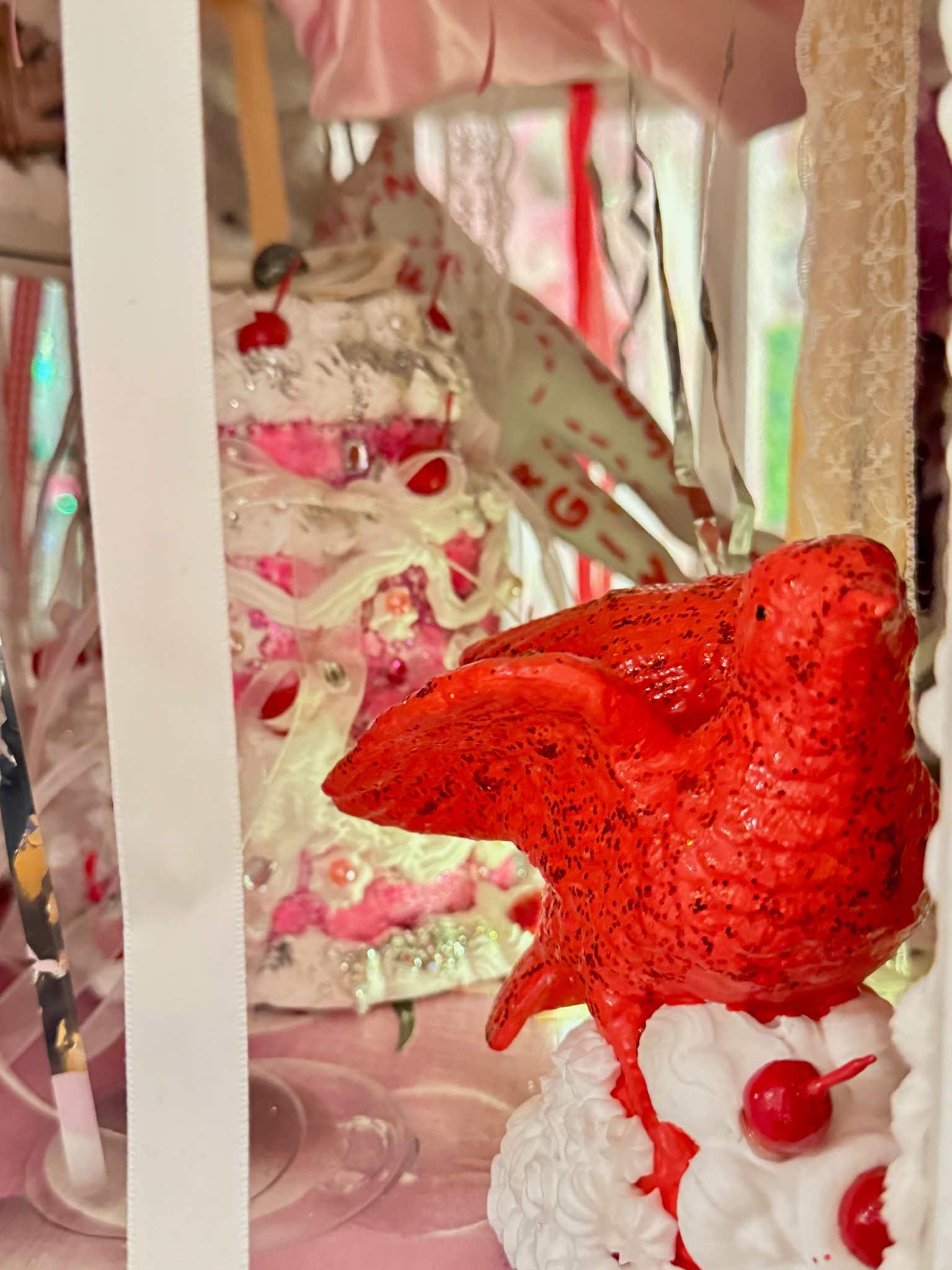
The vibe of this room can be summed up as “sensual skepticism.” To give it an even more disorienting feel, streamers of lace, ribbon, and satiny fabric hang down from the ceiling, concealing your view through to the other side. If you do make it to the other side, you will see a glittery red bird sitting atop still more frosting and cherries. My first romantic relationship: Nathan Stilwell and I met at 18 and married in June of 2000, just before our 21st birthdays. According to the rules of our Evangelical Christian university, only then were we permitted to live off-campus without a curfew, travel together, and were free to have sex. The red bird represents the perverse calculation forced on us in order to gain our freedom. Shared rebellion against our upbringings brought us together and it was there that our mutual story began.
Home Room
The last room inside the dollhouse encompasses the places Nathan and I have lived since marrying: China, New Orleans, and New York City. Having only one room remaining in this house, I searched for a theme that could possibly connect these different places together. I settled on celebration — for the elaborate holidays in China with fireworks, for Mardi Gras season in New Orleans, for New York City with parades galore and the New Year’s Eve Ball — and all with incredible food to boot! With vanishingly fewer occasions to gather and revel, it feels deliciously spiteful to celebrate in excess anyway. This room is a celebration of lives lived.
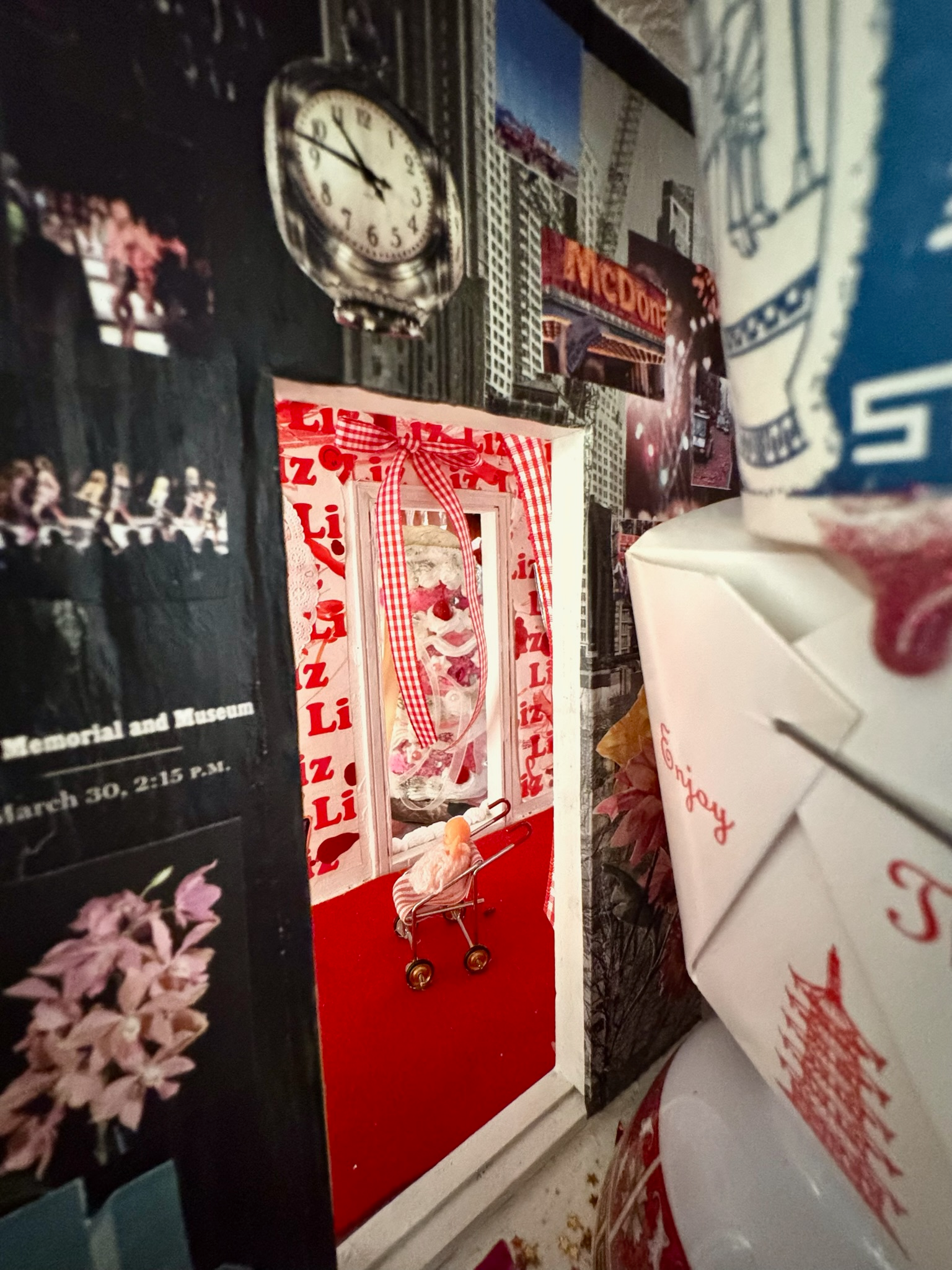
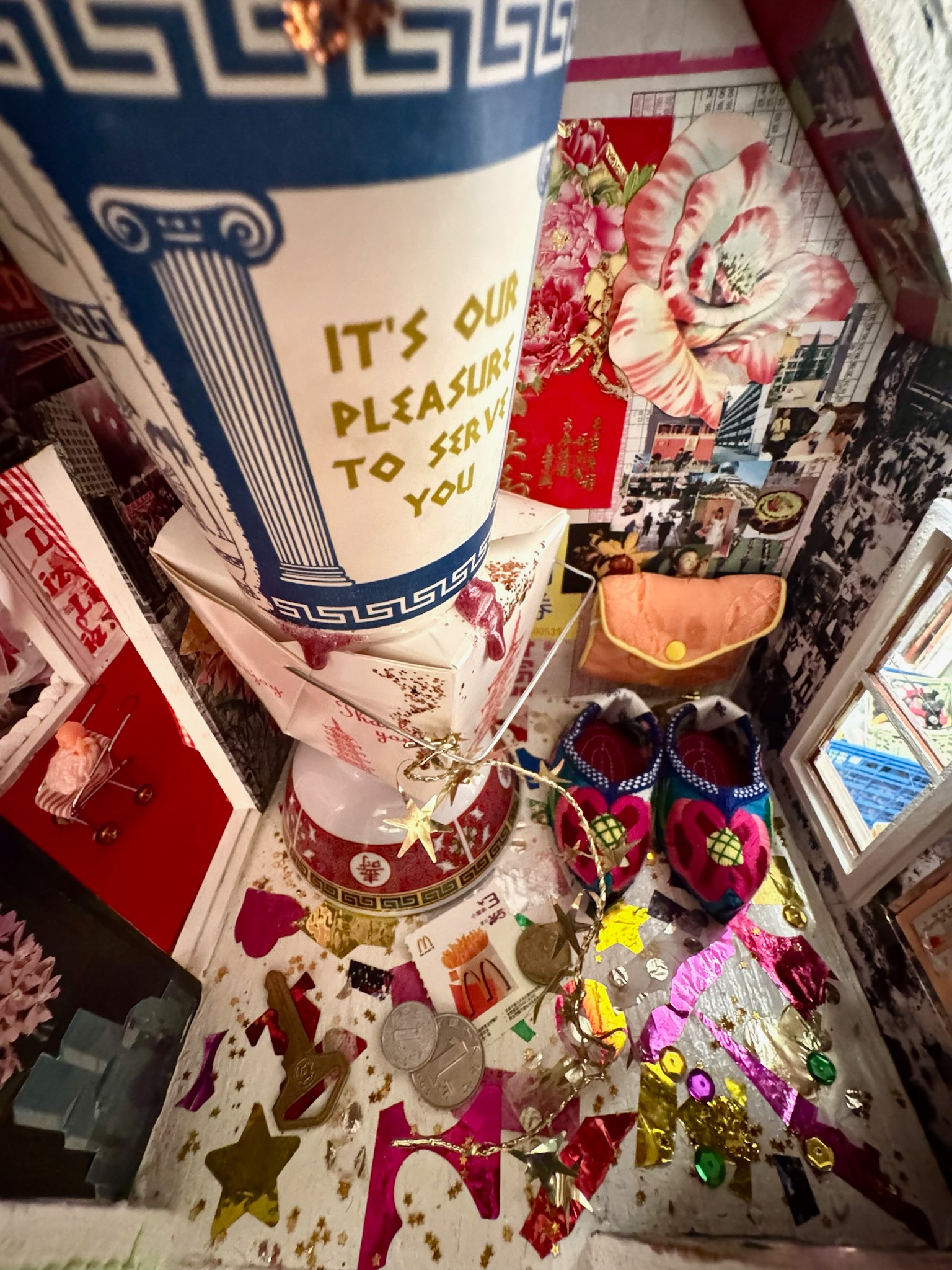
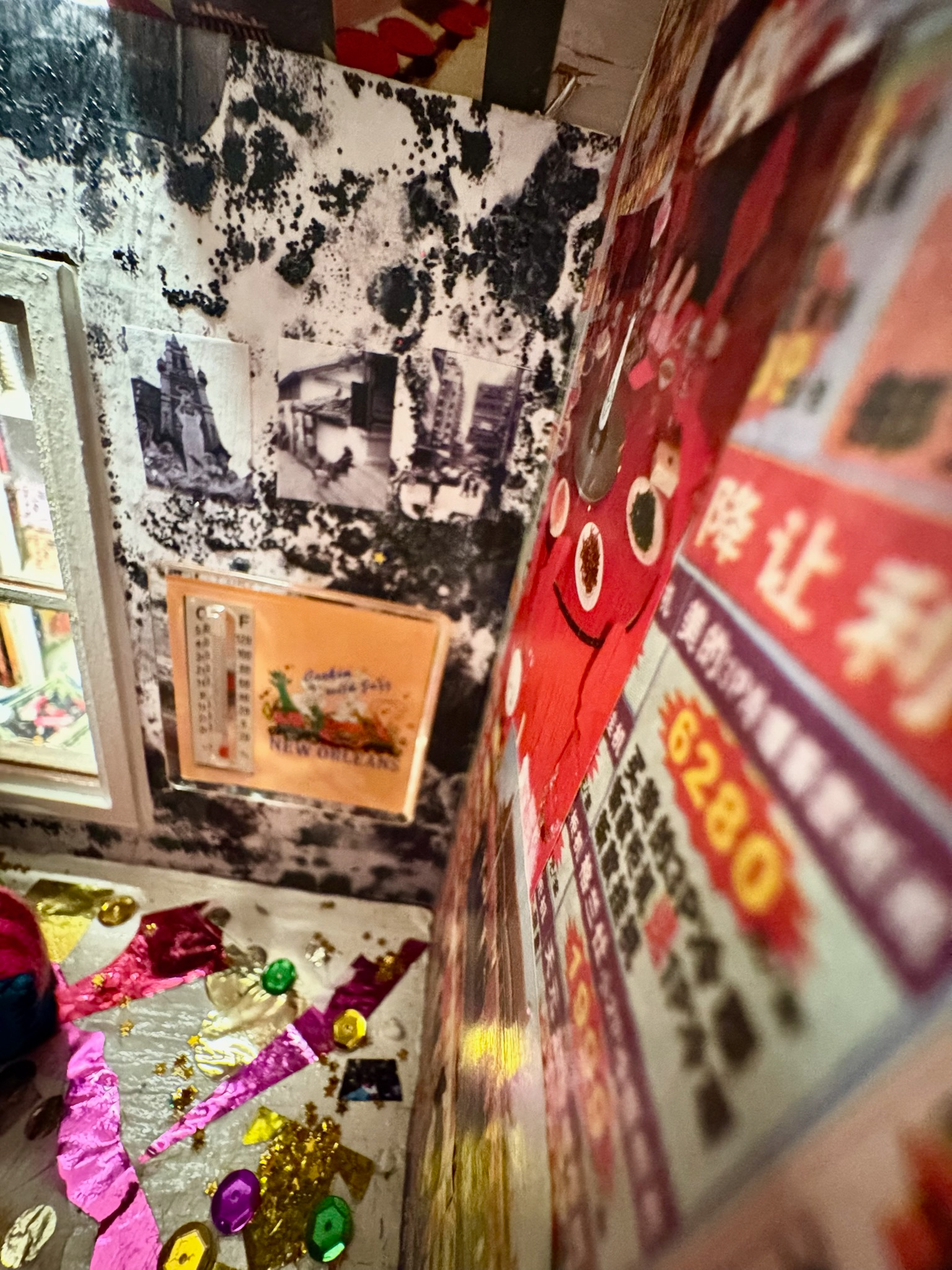
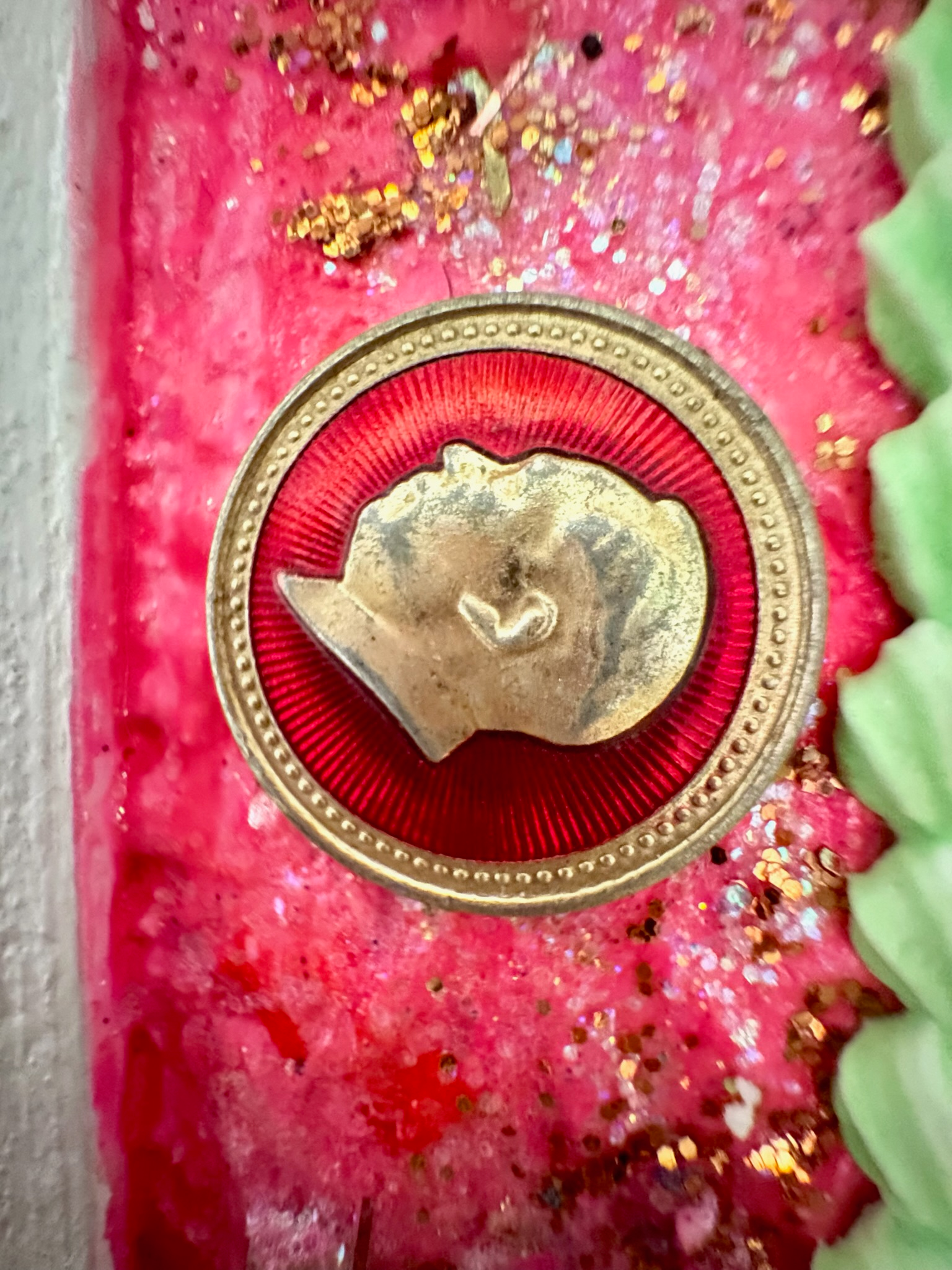
Nathan completed a computer science degree in 2003, but the tech industry was in shambles and companies were outsourcing to Asia, ironically. Rather than stay in Arkansas after graduating, we took jobs teaching English in Hunan Province, China. We were placed in public universities with suspiciously little oversight from an organization called China Now. Foisted onto the Chinese people as we were, we found them more than gracious hosts — and completely failed at our actual assignment, which was proselytizing students through English Bible study. Instead, with real distance from corporate worship and the small minds of the church, we started de-programming ourselves. The back wall is dedicated to the China that helped me grow. It is layered with photos of friends, travels, weddings, and celebrations, train schedules, a red envelope, and other ephemera I lovingly collected. The right side of the floor holds souvenirs of tiny felt baby shoes and trinkets contained in a silk pouch. The front of the room is scattered with Chinese currency, a McDonald’s coupon, and the key to our apartment in Nanjing.
Following our contract year in China, Nathan and I returned to Florida as planned and eventually moved to New Orleans. We excitedly moved there in July of 2005 and then — on August 29th, Hurricane Katrina made landfall. After only a few weeks in our new apartment, we evacuated to Arkansas and were not able to return for months. The large orange X spray painted on the front of the house functions as a reminder of the people missing and lost during Katrina and the failure of the government to help us. The water lines and the mold are other lasting memories I have of that time. The right side of the room is papered with a photo I took of mold on a wall in a church building that had flooded. A souvenir New Orleans thermometer magnet is affixed to the wall, gesturing to the heat and humidity of the south and the fossil-fueled climate conditions that led to Katrina. On the wall, over the mold, are photographs I took of street jazz musicians — memories of better times. We barely had time to make a life there, so after a few months living in FEMA housing, Nathan and I made the decision to return to China. After another four years making our home in Hangzhou and then Nanjing, we made the move to New York City, where my parents then lived.
The left wall is papered with images of New York cut from magazines or taken by me of fashion week, protests, and parades. The floor is covered with confetti I collected from the Spring Festival parade in Chinatown. Placed on the back left of the floor is a stack of collected takeout containers from restaurants. Since living in New York, we also experienced Hurricane Sandy in 2012, and lived through COVID in 2020. That same year, a different kind of catastrophe for my family: my brother Matt died suddenly in Brooklyn, at 38 years old. My only sibling, I turned to creating art as a way to process my grief and loss. A small decorated urn sits in the corner of the room, holding a place for him. New York was his favorite city and it feels right for him to be there, eternally celebrating with us.
Roof
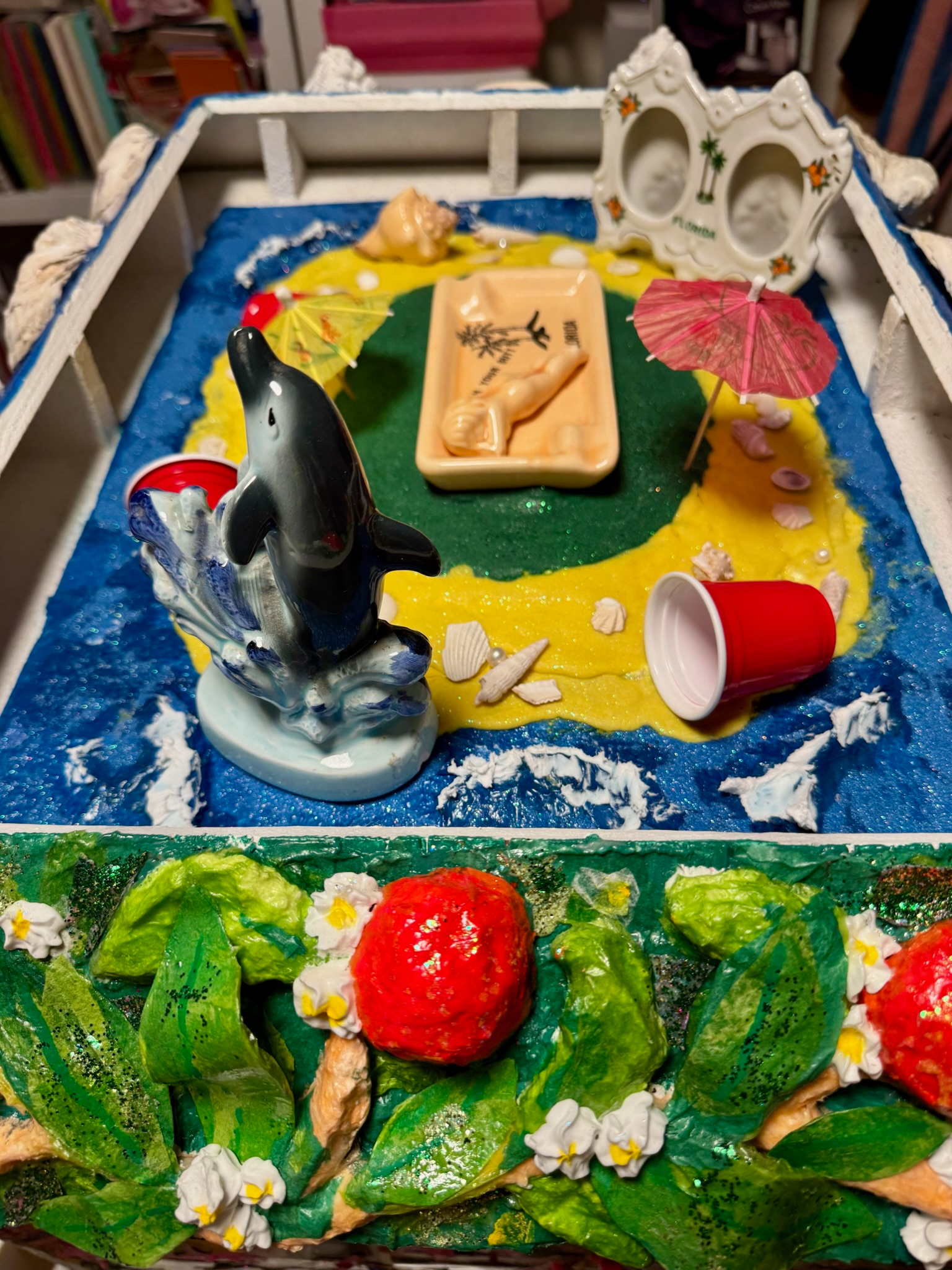
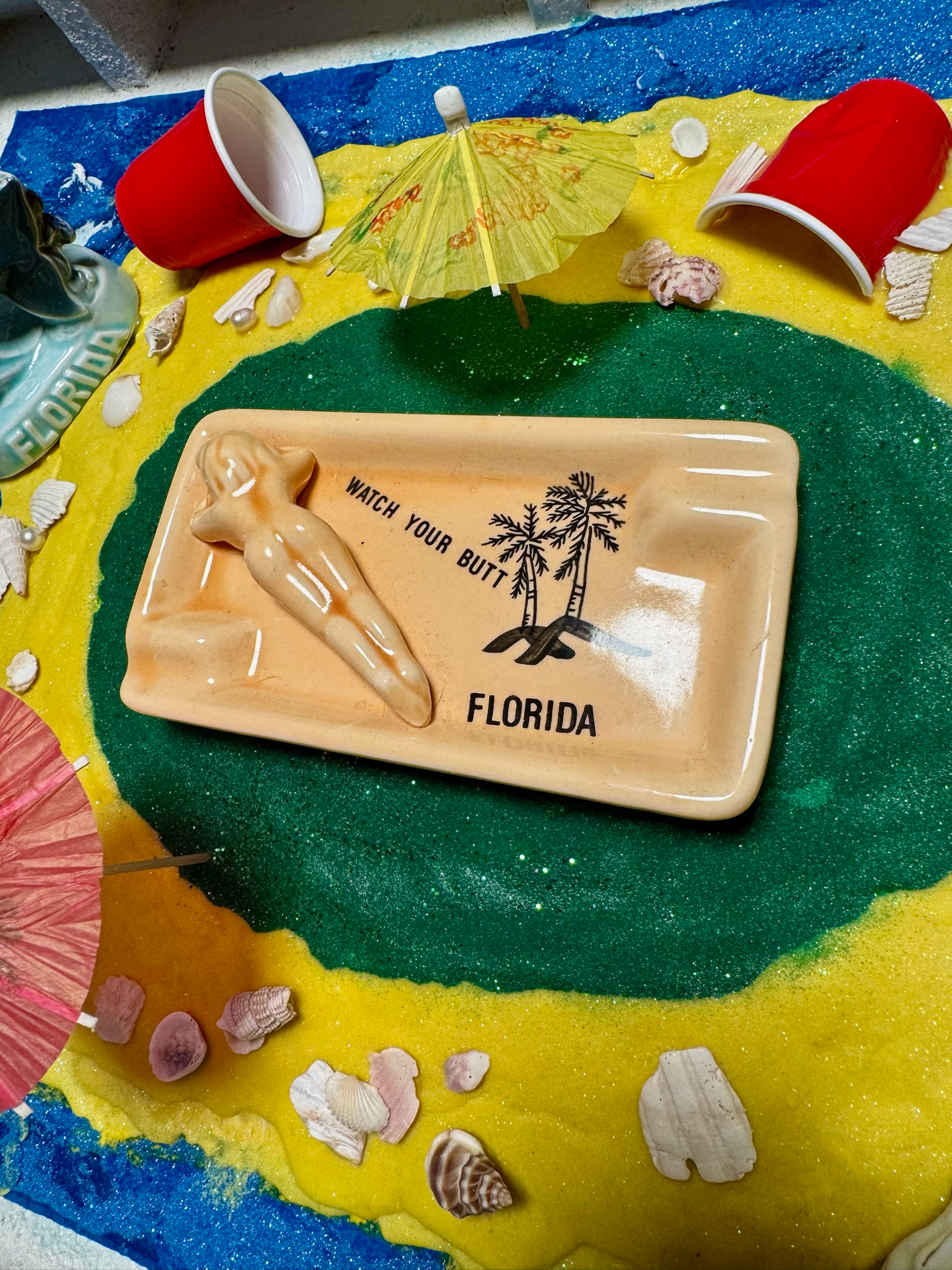
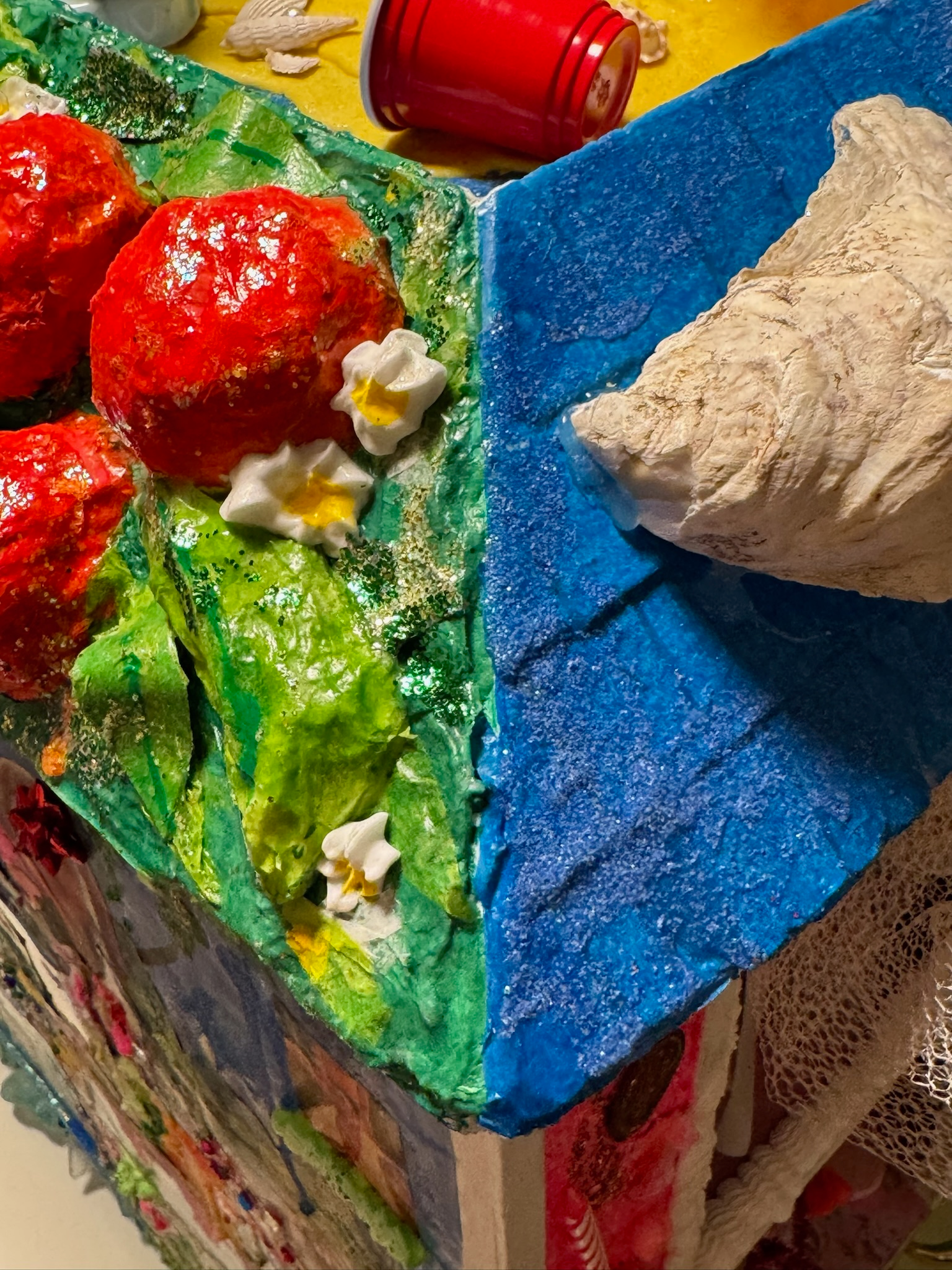
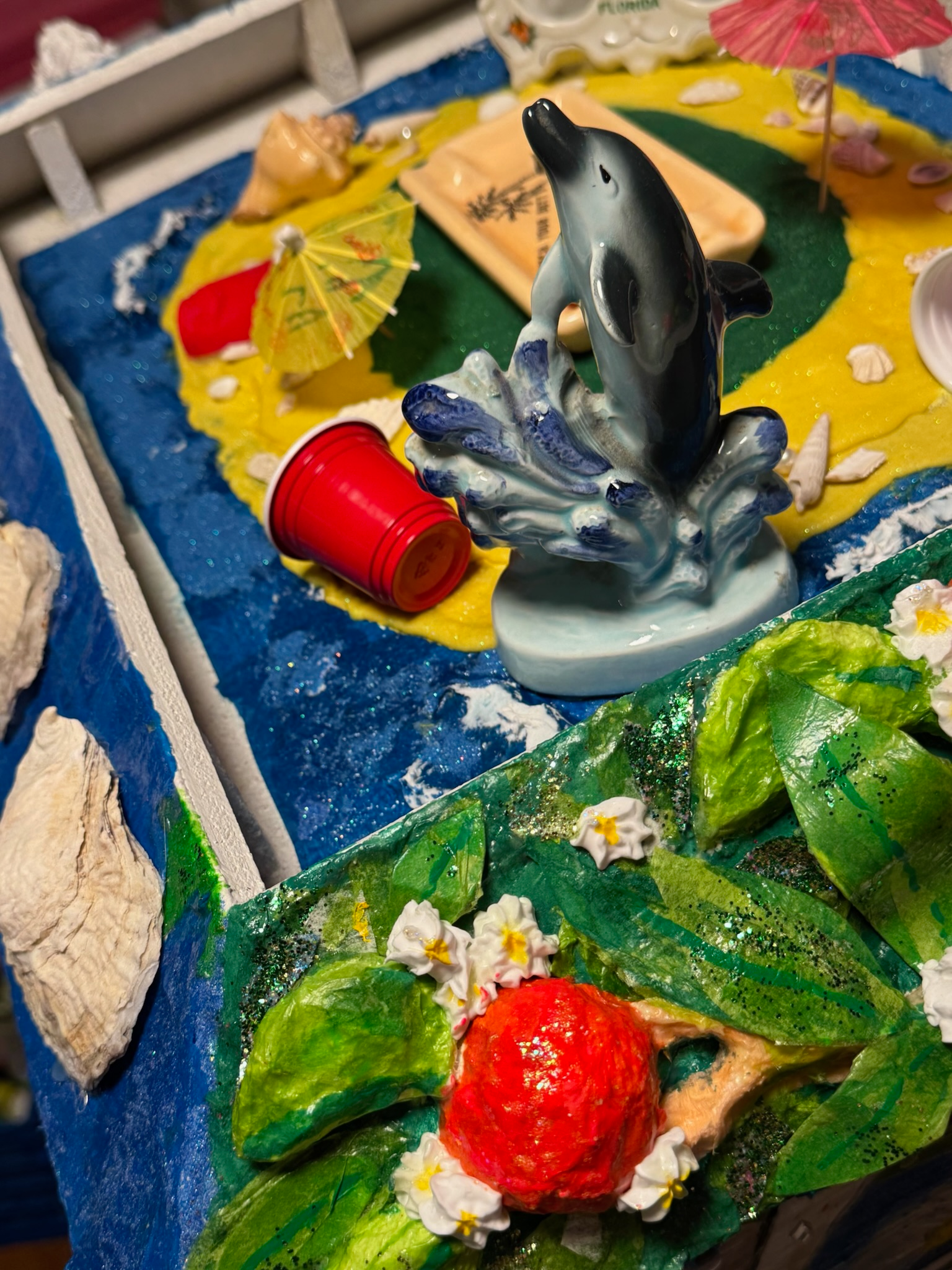
Finally through the house, go up to the roof to relax! Florida souvenirs stand erect in the blue ocean, yellow beach, and green land I created with colored sand. Atop the green sand in the center, a vintage ashtray displays a naked woman lying face down in the sand and threatens, “Watch your butt Florida”. She is surrounded by yellow sand scattered with seashells, red Solo cups, and paper drink umbrellas. Encircling the beach are ocean waves made with tissue paper, blue sand, and white spackle. A souvenir thermometer in the shape of a dolphin and a souvenir frame jut out of the waves. Blue shingles and oyster shells I collected in Florida extend the ocean over the sides of the roof.
Kept in a drawer, keepsakes are meant to freeze a moment in time — but they also have a built-in expiration date. The meaning holds only as long as someone is alive to remember why it was kept. Within an artwork meant to be seen, witnessed, photographed, written about, and exhibited, these objects transcend time and can survive independently. Despite our family challenges, I know that I was loved, and that I am loved, and I am satisfied to memorialize that.